Wednesday, November 6, 2013

Strength training for runners

Sarah Robertson came to me a few years ago with dilemma and a challenge, having only been a 5k runner for a number of years, the initial consultation went along these lines:

S-“I haven’t trained in 8 months owing to a double ITB problem as in both legs have been written off by the physio”
Me- “So you need a rehab programme to get you on the mend before you start training for your 5k events”
S- “kinda, I want to run a marathon”
B- “okay no problem when are you looking at”
S- “That’s the dilemma”
B-“Why”?
S-“It’s the Jersey marathon and it is in six weeks”
B- “oh”

So based on that we discussed the challenge and despite trying to persuade her to wait a while, we started the programme.
Sarah posted 4hours 45 minutes for her first attempt which given the injury and time period for training was a great effort.

From there a relationship between Coach and athlete grew, with Sarah coming up with more little goals in between her main goals. Remembering her only goal was to do 1 marathon, in her first year we completed three marathons and a number of 5 and 10k events with a half marathon for good measure.

Year 2 was the laughable one “I will just concentrate on half marathons this year”, that lasted all of two minutes when I heard “Will you train me for an ultra”? (An ultra marathon being any distance beyond marathon distance.)

The good thing was Sarah trusted me with regard to her training and despite many of her peers and fellow runners telling her it was all wrong, “runners don’t train like that” we kept going.

Sarah was introduced to Olympic lifting, kettlebells, sledges, trx, tyres, weight vests, hypoxic training, TUF (technique under fatigue) and so much more. Her running style and programme completely changed introducing hill reps, sprints, working the curve in reverse doing speed power then endurance. Most of all she was asked for constant feedback which was something new to her!

Sarah forms part of our Athlete performance programmae and has kindly given a testimonial which can be read below—


Running a marathon was an ultimate goal. It scared the hell out of me but I wanted to try it just once. Sure, I could have downloaded a training programme from the internet but I knew I needed a bit more of a ‘push’ – and I had a few wee injury niggles to resolve. I needed some help with this challenge.

Having trained previously as part of a group instructed by Brian, I knew he had the mix of knowledge and motivational skills that would get me through. And he did. There was only one ‘problem’.

He made this and other challenges seem achievable. It seemed logical after a few marathons to look to other challenges and I wondered how far I could go, could I complete an ultra marathon? After my first 53 mile race, we found out – yes, I could. My goals change and evolve because I gain physical strength and mental confidence from training with Brian.

We have now completed two competitive years and I have had no injuries to hamper my training. Yes, training can be hard work sometimes but he also makes it fun too and the results are worth it. Brian makes me realise I can achieve more than I ever thought I could.

Her strength exercises consisted of the following basics, with a variety of others at different stages of the programme.

Clean and Press


Reason
The exercise involves strength and speed and works the deltoids, trapezius, quadriceps, hamstrings, glutes and triceps.

Deadlift


Another strength and speed exercise targeting the lower back trapezius, quads, hamstrings and glutes

Squats

Picture to follow

The squats are a great strength exercise and target the quads, hamstrings, hips and lower back

Sissy lunges


This exercise - a variety of a standard lunge - is not vastly used but is great for strengthening the vastus medialis muscle which helps to align and track the kneecap properly. If you strengthen this muscle it can help prevent runners knee/knee pain.

Charlies Angels

A variety of the Gun drill exercise


Plyometric exercise aids running economy and all runners should incorporate single leg exercises into their programme, the additional benefit of this type of jumping lunge is the rotation of the torso which helps promote stability in the abdominal and lower back areas.

Kettlebell swing


The kettlebell swing is both a strength and power exercise. The swing strengthens the back, shoulders, torso and posterior kinetic chain, It also promotes functionality of the body as in it works as one unit rather than isolating the muscle groups.

Kettlebell single leg deadlift


Targets the posterior chain and torso , inclusive of hamstring, glutes and erector spinae which help with posture , which are also involved in running, and jumping, they are responsible for generating hip and back extension power. Aside from the performance and posture promotion, keeping these muscles in good shape is also important for injury prevention.

Since the initial programme Sarah has competed in over 13 ultra marathons (ranging in distance from 33 miles to 95 miles), marathons, duathlons, x country events and is one of only five women in Scotland to have completed five ultra races in the 2013 Scottish Ultra Marathon Series.

What will next season bring?

Friday, July 5, 2013

Strength and conditioning for triathlon part two


Strength and conditioning for triathlon part two

in the last issue we looked at two forms of squats, this issue we will look at two more types of leg exercise, namely the step up and bulgarian split squats. Both exercises re great single leg exercises for developing strentgh.

The Step Up
Ensure that the box used for this exercise is

> 12-18" minimum off the floor
> or at least high enough to create a right angle on the knee bend non
> slip surface on the top wide enough for the lifters foot to be placed
> fully on top

> Ensure that the bar is approximately armpit height, move towards the bar and place the bar in the low or high position across the back, hips and feet should be directly below the bar.

> a pronated grip approximately more than shoulder width should be adopted.
> elbows should be raised to form a shelf to be created across the back
> so the bar does not slip

> step up onto the box from a standing position with the lead leg, ensure the trail leg is in contact with the floor.

> do not push off the trail leg, ensure that your torso is square and erect throughout the exercise.

> pause at the top of the exercise and

> then shift your weight back to the trail leg before returning the lead leg back to the start position.


*ensure that a spotter is used throughout the exercise


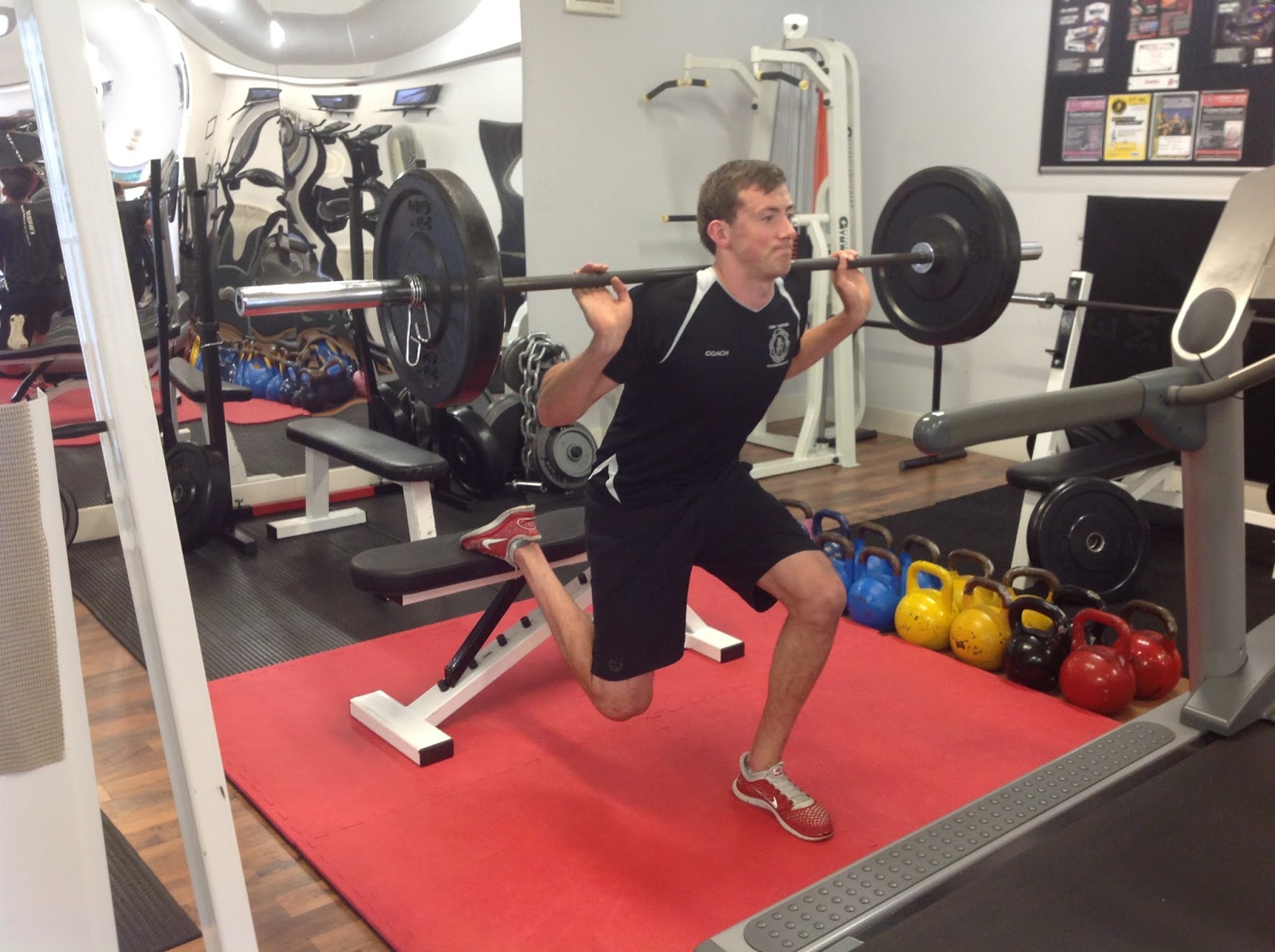
Bulgarian split squats

> grasp the bar in a pronated grip and the bar is in the low or high position across the back, grip should be just outside shoulder width apart.

> stand in front of a bench or box and place the rear foot on the bench

> Ensure that your weight is placed evenly throughout the lead foot with
> the knee in line with your toes

>lower to a point ensuring the the thigh of the lead leg is parallel or
>almost parallel to the floor

> Ensure that the torso remains erect and square to avoid bending over

> the knee should not lock out at the top of the movement.


both of these exercises are great for single leg strength and should be practiced regularly throughout your strength and conditioning programme.


Thursday, May 16, 2013

Krusty Kreme or the gym


It happens every January/February an influx of New Year’s resolution-makers amble in through the doors of their nearest gym in their box-fresh trainers and shiny new Lycra ensembles. Don't get me wrong, I have nothing but respect for anyone who takes up a fitness regime. What makes me seethe is that perennial breed of gym-goer who thinks they will get in shape simply by turning up. Not for them feeling the burn or working up a sweat. Instead they hang around chatting by the water coolers, cluttering up the fitness machines, taking up space in classes whilst never actually doing anything remotely resembling a workout.
What is even more alarming is the fact that Scotland is claimed to have the most unfit, unhealthy occupants in the UK. Why is Scotland not fit? Who is to blame? Why don’t we eat healthy? Do we blame the recession? Or is it sheer laziness? Is it bred in us to be unhealthy?


Maybe the alarming fact that despite the cold snowy weather, Scotland’s capital saw the launch of a new Krispy Kreme Doughnut store which saw around 300 people waiting anxiously for the doors to open at 7am, on Wed 13th Feb. Since the arrival of store 2 weeks on and you’re still experiencing queues at the Hermiston gate store, Lothian and Borders police have been urging motorists to avoid the western side of Edinburgh altogether due to the chaos. Patrol cars are being sent to Hermiston Gait Retail Park daily to try to stop Krispy Kreme customers causing gridlock to avoid mile-long tailbacks backing on to the M8. This broke the company’s record for the first hour sales of any UK store opening. So what is the attraction? Is it the taste of the 16 different flavoured doughnuts or the fact that everyone else is doing it?


Health campaigners said they were appalled at the number of people prepared to wait in their cars to buy the cholesterol-packed snacks and quite rightly so with the average intake of 430kcal in 1 doughnut and a whopping 23 grams of fat if Edinburgh is overweight today then it will certainly be obese by tomorrow.

So what do we do? How can we sort this? The government is looking to bring out new legislation… Fizzy drinks should be taxed, fast food outlets near schools limited and new parents given specific advice on how to feed their children properly to help tackle spiralling levels of obesity. Is this the way forward? Can we do more?

One in four adults in the UK is obese, figures say, a number expected to double by 2050. Doctors fear the obesity crisis is becoming "irresolvable", and are calling for society "as a whole" to act before it becomes irreversible.

So this is a problem for not just one area but for the country as a whole the NHS, government, councils, schools, parents, workplaces as with obesity comes poor health, poor diet, poor fitness. With the commonwealth games just round the corner are we really promoting healthy living, a better nation with Krispy Kreme queues? I long for the day when a local gym makes the headlines for weeks as it’s the new craze and the queues to enter are avoidable to enter!


Theresa Penrice
West Lothian College
Sport and fitness department
(work experience)

swim article in Go Guide


See our latest article in Go Guide magazine