Showing posts with label west lothian. Show all posts
Showing posts with label west lothian. Show all posts
Tuesday, September 10, 2013

Friday, July 5, 2013
Strength and conditioning for triathlon part two
Strength and conditioning for triathlon part two
in the last issue we looked at two forms of squats, this issue we will look at two more types of leg exercise, namely the step up and bulgarian split squats. Both exercises re great single leg exercises for developing strentgh.
The Step Up
Ensure that the box used for this exercise is
> 12-18" minimum off the floor
> or at least high enough to create a right angle on the knee bend non
> slip surface on the top wide enough for the lifters foot to be placed
> fully on top
> Ensure that the bar is approximately armpit height, move towards the bar and place the bar in the low or high position across the back, hips and feet should be directly below the bar.
> a pronated grip approximately more than shoulder width should be adopted.
> elbows should be raised to form a shelf to be created across the back
> so the bar does not slip
> step up onto the box from a standing position with the lead leg, ensure the trail leg is in contact with the floor.
> do not push off the trail leg, ensure that your torso is square and erect throughout the exercise.
> pause at the top of the exercise and
> then shift your weight back to the trail leg before returning the lead leg back to the start position.


*ensure that a spotter is used throughout the exercise
Bulgarian split squats
> grasp the bar in a pronated grip and the bar is in the low or high position across the back, grip should be just outside shoulder width apart.
> stand in front of a bench or box and place the rear foot on the bench
> Ensure that your weight is placed evenly throughout the lead foot with
> the knee in line with your toes
>lower to a point ensuring the the thigh of the lead leg is parallel or
>almost parallel to the floor
> Ensure that the torso remains erect and square to avoid bending over
> the knee should not lock out at the top of the movement.

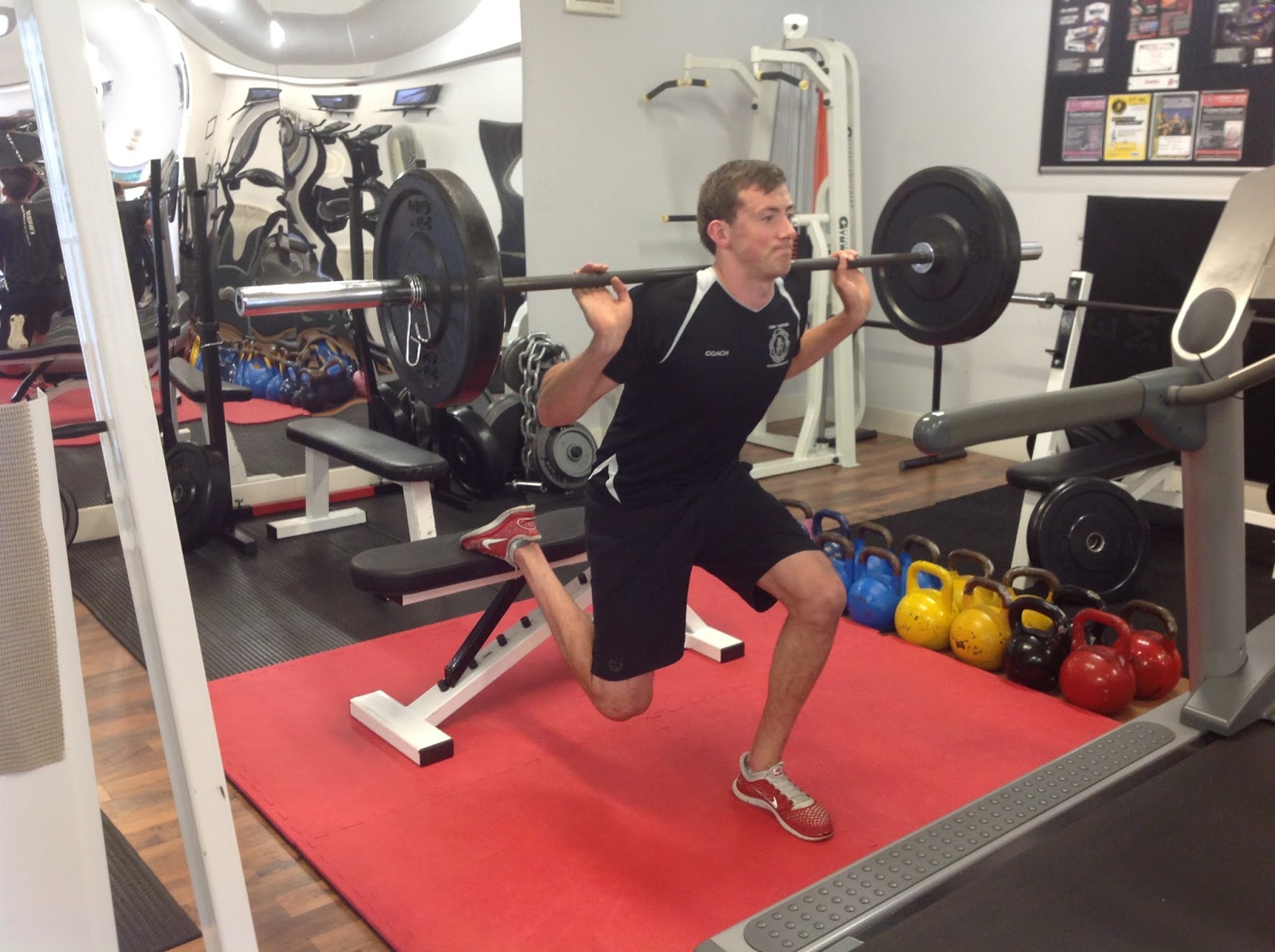
both of these exercises are great for single leg strength and should be practiced regularly throughout your strength and conditioning programme.
Friday, April 26, 2013
Wednesday, January 30, 2013
Conditiong circuit
Boxing Coach Wille and boxer Stephen with Coach Ann (GI pain)
http://youtu.be/3KKlOXg07ps
Tuesday, January 8, 2013
When not to train
As winter is upon us there are more and more illnesses kicking about. There are lots of different opinions about training with illness. Some say to stop training altogether others say, slow training down or continue as normal. Here is my take on what you should do when you have common illnesses and tips for every gym goer out there.
Firstly if you have a fever-
Symptoms include-
• Sweating
• Shivering
• Headache
• Muscle aches
• Loss of appetite
• Dehydration
• General weakness
Should you train? No. When the body’s immune system is fighting infection it doesn’t need to deal with the added stress of exercise.
The common cold
Symptoms include-
• A blocked nose
• Nasal pain and irritation
• Sneezing
• A runny nose
• Coughing
• A coarse voice
• A general sense of feeling unwell
Should you train? Moderate intensity workouts are ok when you have cold systems. However if you go the gym when you have a cold use hand sanitizer and wipe all surfaces you touch as you don’t want your buddies catching it.
The Flu
Symptoms include-
• Sudden fever
• Dry, chesty cough
• Headache
• Tiredness
• Chills
• Aching muscles
• Limb or joint pain
• Diarrhea or upset stomach
• Sore throat
• Runny or blocked nose
• Sneezing
• Loss of appetite
• Difficulty sleeping
Should you train? No. Head to the couch not the gym. Don’t work out until you have recovered, with flu comes a fever so read above and skip training until recovered.
Here are a few other contraindications that may have an effect on your training.
Didn’t sleep last night?
The best thing you can do is get out of bed and get moving. A morning workout is just what you may need after a restless night to boost your energy levels and get you prepared for the day ahead.
D.O.M.S?
Delayed onset of muscle soreness, after a hard session you might be in pain what I would suggest is go to the gym, make it a light intensity workout such as walk rather than run or do a cardio day rather than a heavy weight session. It is also ok to skip a workout if the pain is too much.
Hope this helps with all those runny noses this time of year. No more excuses for skipping work outs,
(Always check with a your GP about contraindications before exercising)
Ryan Stewart Personal Trainer
Friday, September 7, 2012
Friday, February 17, 2012
Born Free!!
What is your first thought when it comes to fitness? For most it’s the thought of a packed out gym, full of body builders to the glamour girls in there Lycra. The majority of us are very self-conscious so the gym is a very intimidating place to go. What if I told you, that you could seek all your fitness goals for free and not have to step one foot into a gym. Sound good? The great outdoors so misunderstood though the fun you could have and the benefits you could receive from exercising outdoors are endless.
It’s Free!!
No membership payments or the struggle to get on a machine. The outdoors is everyone’s to share and enjoy. You don’t need specialised equipment to get fit; you just have to know where to start. The outdoors is always open with no time limits, no restrictions on what you can and can’t do.
Fresh Air
Nothing beats the outdoors for clean air, yes nowadays we are doing what it seems are utmost to pollute our world the outdoors is still twice as clean as air you’d find in a gym.
More Freebies
Yes I give you more freebies much better than your free water bottle and towel you usually get. As you may know the body needs vitamins and nutrients to function properly. Through the sunlight your body receives doses of vitamin D enough without worrying about taking any supplements. Another little bonus you might even pick yourself up a little tan, ok rare but you never know.
Open your Mind
While outdoors your mind becomes more active as it has to take in its surroundings, from hills you climb to a winding path or to the terrain you’re on.
Open your mind; open your heart to the outdoors.
Dave Low
Personal Trainer
Thursday, January 26, 2012
Fighting Fit

More and more people now a days are incorporating boxing in to their training schedule, whether it be in a fitness class or playing around with your gyms punching bag putting yourself through the paces. The benefits to boxing are endless and for to start with you don’t need to be the next Muhammad Ali to enjoy the boxing experience.
A boxing workout can be suited for all fitness levels to the very beginner to the sessional pro the benefits are still the same. The combinations and technique can be changed depending on the client with the intensity either increased or decreased.
Boxing is usually seen as a male dominated activity, as due to the physical nature of boxing, though the aspects and benefits of boxing are just as beneficial to ladies as it is men.
For prime example calorie and fat burning are increased due to the intensity of such an activity. As with boxing the workout entails you to use the larger muscle groups and they are constantly been put through their paces increasing the work load. More importantly for women boxing doesn’t add muscle bulk but more toning giving definition to the muscle.
With fitness just being one of the many benefits, boxing training also allows you build a functional physique while provide self-confidence.
The actual boxing workout itself may involve pad work, bag work even a little shadow boxing to the more intense sparring depending on your level of experience. There even might be a few cardiovascular and strength drills so the body is fully conditioned.
As with any new activity you give a try to it is also vital your aware of the safety issues and ensures correct technique is maintained. Go on give it a try; instead of being fit you could be fighting fit.
David Low
Personal Trainer
Thump Boxing Instructor
Saturday, November 26, 2011
members comments
Below are some of the comments from our members since opening in June this year. All comments can be viewed by visiting us @ Fit Inc, studio, gym and dojo West Lothian's Premier Training Centre.
Great help from Wullie and Dave, Good guys very helpful
Robert, Polbeth
Fab street gym with big wullie, learned some new stuff, Thanks
Audrey, newbrudge
Brilliant kickboxing tonight, Thank You Brian
Morag Pumpherstoun
Ann you are legend!
Dizzi Kirkliston
Thanks Brian Feel like I'm dying, another good street gym
Kim Bathgate
Brilliant class Ritchie, beasting us as per
Tracey, Livingston
Quality Circuits
Leo, Livingston
T.O.D Combat the only way to reach peak fitness, awesome training
Craig, Kuk sool won Dunfermline
Military Training? doesnt feel it but it's worth it
Gordon, Currie Edinburgh
Fab workout, Matthew your the biz
Ann Broxburn
Military Training = Pain but very good
Mark, Bathgate
First time back at spin for two weeks, FAB cheers Dave
Carol Livingston
Run club 5.8 miles good fun cheers Lucy
Angela, Livingston
Great core complex class, thanks Ryan
Jenny, Dedridge
Great spin class dave
Lorraine, Livingston
loved the Ton up class, could be longer than 30 minutes thanks David
Tina, Howden
Julianna thanks for the class and and tips
Carol, Murieston
fabby induction by the boss
Karen, Livingston
showers amazing, poles at street gym are a nightmare
Linda howden
loving body pump and getting used to run club
Carol, Livingston
core complex and hells bells great class
Martin, Pumpherstoun
ladies kickboxing, love it
Sharon, Kirknewton
Great help from Wullie and Dave, Good guys very helpful
Robert, Polbeth
Fab street gym with big wullie, learned some new stuff, Thanks
Audrey, newbrudge
Brilliant kickboxing tonight, Thank You Brian
Morag Pumpherstoun
Ann you are legend!
Dizzi Kirkliston
Thanks Brian Feel like I'm dying, another good street gym
Kim Bathgate
Brilliant class Ritchie, beasting us as per
Tracey, Livingston
Quality Circuits
Leo, Livingston
T.O.D Combat the only way to reach peak fitness, awesome training
Craig, Kuk sool won Dunfermline
Military Training? doesnt feel it but it's worth it
Gordon, Currie Edinburgh
Fab workout, Matthew your the biz
Ann Broxburn
Military Training = Pain but very good
Mark, Bathgate
First time back at spin for two weeks, FAB cheers Dave
Carol Livingston
Run club 5.8 miles good fun cheers Lucy
Angela, Livingston
Great core complex class, thanks Ryan
Jenny, Dedridge
Great spin class dave
Lorraine, Livingston
loved the Ton up class, could be longer than 30 minutes thanks David
Tina, Howden
Julianna thanks for the class and and tips
Carol, Murieston
fabby induction by the boss
Karen, Livingston
showers amazing, poles at street gym are a nightmare
Linda howden
loving body pump and getting used to run club
Carol, Livingston
core complex and hells bells great class
Martin, Pumpherstoun
ladies kickboxing, love it
Sharon, Kirknewton
Monday, October 17, 2011
Running sessions
You have permission to publish this article in websites, electronic publications. Ezines and any media format, as long as the article is published in its entirety, including the resource box, all hyperlinks, (HTML clickable), references and copyright information.
RUNNING SESSIONS
Much has been written about running over the years and many forms and types have been developed, the most and common types being Interval, resistance and distance. The following is to give you different ideas regarding types of run training in order to progress you as an individual and ensure that running does not become a set route, time or type. The list is by no means exhaustive and many forms can be mixed together in order to progress and challenge yourself.
Running is a suitable activity for most people. This form of long continuous exercise increases your oxygen uptake and allows your metabolism to function more efficiently. Regular running makes the lungs work more efficiently allowing more air to reach the blood as it is pumped through the lungs. It also increases the number of red blood cells in the blood and muscles allowing more oxygen to be extracted from the air which enters the lungs. Other effects of running training are:
- drop in pulse rate
- increase in working capacity of the heart
- increased pressure on circulatory system will open up underdeveloped arteries
- new capillary beds will develop (small blood vessels)
- more efficient blood circulation to and from muscles
TYPES OF RUNNING TRAINING
FARTLEK TRAINING (SPEED PLAY OR ALTERNATE PACE TRAINING)
The Swedish coach Gosta Holmer introduced this form of training in the early 1930s. Fartlek is done on a soft surface, ideally the pinewood needle surface of a forest path. It is done on undulating ground so that there is plenty of uphill and downhill running.
Fartlek is a combination of great quantities of easy running, interspersed with sprints and periods of resistance running up hills. The advantage of fartlek is that a lot of good solid running can be done without the factor of boredom appearing. Forest tracks wind continually and the view constantly changes. It is controlled by time ie you would go for a 20, 30 or 40 minute as opposed to going out for a 3, 4 or 5 mile run.
It would be wrong to lay down set intervals for types of work in Fartlek session but the following types of running are examples of running that may appear in a Fartlek session:-
a. fast 60m sprint on flat surface
b. steady strides (70 seconds, 400 metres speed) for half mile
c. 40-100 metres fast as possible uphill
d. fast strides for 400 metres downhill
e. light manning with occasional inclusion of 4/5 fast strides for 3 minutes
f. brisk walk for 3 minutes
g. light even paced running with short acceleration spurts 50-60 metres for 5 minutes
h. jogging and rhythmical exercises for 5 minutes
The sprints and uphill work will force the body into periods of anaerobic work resulting in oxygen debt. This debt must be repaid during the low intensity parts of the cycle. The method educates the body to improve its’ oxygen uptake and speed of recovery. The whole session should be joined together by lively jogging and should be enjoyable.
INTERVAL TRAINING
This particular form of ‘punishment’ was developed by Emil Zatopek, the great Czech middle distance runner and was brought to a climax by Britain’s Gordon Pirie. Interval running consists of running a specific number of short distances (between 50-100 metres) in a given time with short rest periods in between. The rest periods are normally spent jogging walking. The main emphasis of this type of conditioning is to develop the heart capacity and to strengthen the heart wall muscle, thereby improving the stroke volume of the heart (the volume of blood pumped at each stroke/beat). To increase the difficulty of the training period, you can:-
a. run the interval in a faster time
b. decrease the recovery distance time
c. increase the number of repetitions
REPETITION TRAINING
A similar type of running to interval running except that the recovery period is long enough for the athlete to get his breath back. The sprinter will do far more of this work than pure interval running. Here, good fast running is wanted in every effort, so the heart and lungs are given a chance to recover before the next run. A rest of 4 to 6 minutes between each run is required.
CONTINUOUS RUNNING
Although interval training develops stamina in the body, it sometimes fails to condition the mind to racing hard over a racing period. Continuous running is done for distances over the normal racing distance at as near possible racing speed. The athlete needs a downhill course with a prevailing wind. He records the best time he can, using a watch and mile markers to estimate progress. During workouts on this basis the athlete is subject to all the mental visions of collapse that he suffers in a race. By fighting his way through these ‘black periods’ in training he makes himself aware of the fact that most fatigue is only in the mind.
TEMPO RUNNING
This type of running can be done anywhere and is normally done for a set period of time or distance, The runner picks a rate that can be maintained at a comfortable pace and maintains this pace throughout, some runners use split times or heart rate monitors to gauge their desired pace E.G 60% of Maximum heart rate.
RESISTANCE RUNNING
Under this category come sand hill, snow and mud running. Running towing equipment such as tyres, trolleys or a partner offering resistance on a harness can also be included as resistance running. In the absence of a harness partners can do the old fashioned methods of
A. Holding onto the waist of the runner and dropping their body weight in a squat position as they offer the resistance, trying to hold the runner back as they move forward.
B. In front of the runner with hands on the shoulders offering resistance as the runner aims to go forward.
PAARLAUF
This form of training is a competitive form of interval running. As in a proper race, two man teams compete against each other. The distance of the race is unspecified, only a minimum and maximum time being given. Thus a race could last from 30 to 45 minutes. After a certain time has elapsed (this time is prior decided but unknown to runners), the referee blows a whistle then for a period of one minute. The winning team is the one who has carried the baton the furthest. The 2 runners can decide how they wish to share the running – they can either run interval quarter miles or every other furlong, jogging across the track to regain the baton.
As a training workout, the number of runners can be increased in a team of 4, 6 or 8. With 8 runners, they could spread out over 400 metres and move with the baton from some 60 metres with about 55 seconds rest before the next effort.
CROSS COUNTRY
The mental stimulus and the physical value of cross country running and racing are invaluable to the middle distance runner. The lengths of the courses vary fro 3 to 10 miles and usually become longer as the season progresses. (For this reason, the miler/3 miler is advised to curtail cross country racing in March by this time, the courses will be too long and in any case it will be time for the athlete to consider returning to the track for most of his work-outs). Cross country running is invaluable for the triathlete a sit aids in core stability and strengthens ankle and knees owing to the nature of the surfaces this type of running covers.
ACCELERATION RUNNING
This type of running can cause confusion and some may think it is a play on words in relation to fartlek. This is not the case and is a recognised and useful form of training. Again pick a distance or set time the main aim here is to start of slow and progress to full race pace prior to the end of the set period. For example a 15 minute run may be split into 30 second segments with the last two minutes being near threshold or race pace as possible.
Alternatively this form of training is used by coaches in football; athletics etc in order to test the acceleration speed of athletes, a normal set for this would be 3 x 30 meter sprints. Take the average of the 3 sprints in order to get an indication of your acceleration speed.
Subscribe to:
Posts (Atom)