Showing posts with label strength. Show all posts

Wednesday, November 6, 2013

Strength training for runners

Sarah Robertson came to me a few years ago with dilemma and a challenge, having only been a 5k runner for a number of years, the initial consultation went along these lines:

S-“I haven’t trained in 8 months owing to a double ITB problem as in both legs have been written off by the physio”
Me- “So you need a rehab programme to get you on the mend before you start training for your 5k events”
S- “kinda, I want to run a marathon”
B- “okay no problem when are you looking at”
S- “That’s the dilemma”
B-“Why”?
S-“It’s the Jersey marathon and it is in six weeks”
B- “oh”

So based on that we discussed the challenge and despite trying to persuade her to wait a while, we started the programme.
Sarah posted 4hours 45 minutes for her first attempt which given the injury and time period for training was a great effort.

From there a relationship between Coach and athlete grew, with Sarah coming up with more little goals in between her main goals. Remembering her only goal was to do 1 marathon, in her first year we completed three marathons and a number of 5 and 10k events with a half marathon for good measure.

Year 2 was the laughable one “I will just concentrate on half marathons this year”, that lasted all of two minutes when I heard “Will you train me for an ultra”? (An ultra marathon being any distance beyond marathon distance.)

The good thing was Sarah trusted me with regard to her training and despite many of her peers and fellow runners telling her it was all wrong, “runners don’t train like that” we kept going.

Sarah was introduced to Olympic lifting, kettlebells, sledges, trx, tyres, weight vests, hypoxic training, TUF (technique under fatigue) and so much more. Her running style and programme completely changed introducing hill reps, sprints, working the curve in reverse doing speed power then endurance. Most of all she was asked for constant feedback which was something new to her!

Sarah forms part of our Athlete performance programmae and has kindly given a testimonial which can be read below—


Running a marathon was an ultimate goal. It scared the hell out of me but I wanted to try it just once. Sure, I could have downloaded a training programme from the internet but I knew I needed a bit more of a ‘push’ – and I had a few wee injury niggles to resolve. I needed some help with this challenge.

Having trained previously as part of a group instructed by Brian, I knew he had the mix of knowledge and motivational skills that would get me through. And he did. There was only one ‘problem’.

He made this and other challenges seem achievable. It seemed logical after a few marathons to look to other challenges and I wondered how far I could go, could I complete an ultra marathon? After my first 53 mile race, we found out – yes, I could. My goals change and evolve because I gain physical strength and mental confidence from training with Brian.

We have now completed two competitive years and I have had no injuries to hamper my training. Yes, training can be hard work sometimes but he also makes it fun too and the results are worth it. Brian makes me realise I can achieve more than I ever thought I could.

Her strength exercises consisted of the following basics, with a variety of others at different stages of the programme.

Clean and Press


Reason
The exercise involves strength and speed and works the deltoids, trapezius, quadriceps, hamstrings, glutes and triceps.

Deadlift


Another strength and speed exercise targeting the lower back trapezius, quads, hamstrings and glutes

Squats

Picture to follow

The squats are a great strength exercise and target the quads, hamstrings, hips and lower back

Sissy lunges


This exercise - a variety of a standard lunge - is not vastly used but is great for strengthening the vastus medialis muscle which helps to align and track the kneecap properly. If you strengthen this muscle it can help prevent runners knee/knee pain.

Charlies Angels

A variety of the Gun drill exercise


Plyometric exercise aids running economy and all runners should incorporate single leg exercises into their programme, the additional benefit of this type of jumping lunge is the rotation of the torso which helps promote stability in the abdominal and lower back areas.

Kettlebell swing


The kettlebell swing is both a strength and power exercise. The swing strengthens the back, shoulders, torso and posterior kinetic chain, It also promotes functionality of the body as in it works as one unit rather than isolating the muscle groups.

Kettlebell single leg deadlift


Targets the posterior chain and torso , inclusive of hamstring, glutes and erector spinae which help with posture , which are also involved in running, and jumping, they are responsible for generating hip and back extension power. Aside from the performance and posture promotion, keeping these muscles in good shape is also important for injury prevention.

Since the initial programme Sarah has competed in over 13 ultra marathons (ranging in distance from 33 miles to 95 miles), marathons, duathlons, x country events and is one of only five women in Scotland to have completed five ultra races in the 2013 Scottish Ultra Marathon Series.

What will next season bring?

Friday, July 5, 2013

Strength and conditioning for triathlon part two


Strength and conditioning for triathlon part two

in the last issue we looked at two forms of squats, this issue we will look at two more types of leg exercise, namely the step up and bulgarian split squats. Both exercises re great single leg exercises for developing strentgh.

The Step Up
Ensure that the box used for this exercise is

> 12-18" minimum off the floor
> or at least high enough to create a right angle on the knee bend non
> slip surface on the top wide enough for the lifters foot to be placed
> fully on top

> Ensure that the bar is approximately armpit height, move towards the bar and place the bar in the low or high position across the back, hips and feet should be directly below the bar.

> a pronated grip approximately more than shoulder width should be adopted.
> elbows should be raised to form a shelf to be created across the back
> so the bar does not slip

> step up onto the box from a standing position with the lead leg, ensure the trail leg is in contact with the floor.

> do not push off the trail leg, ensure that your torso is square and erect throughout the exercise.

> pause at the top of the exercise and

> then shift your weight back to the trail leg before returning the lead leg back to the start position.


*ensure that a spotter is used throughout the exercise


Bulgarian split squats

> grasp the bar in a pronated grip and the bar is in the low or high position across the back, grip should be just outside shoulder width apart.

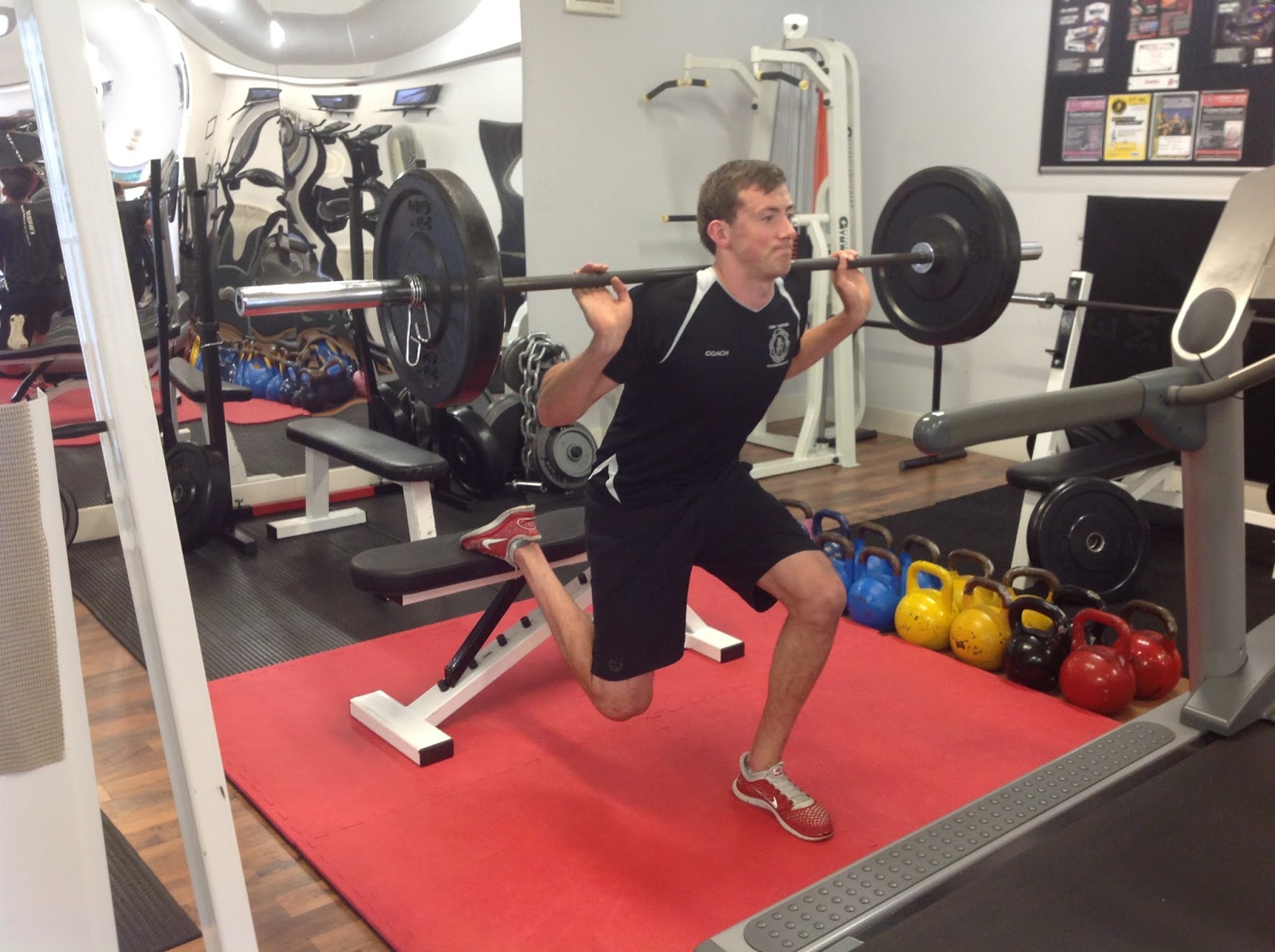
> stand in front of a bench or box and place the rear foot on the bench

> Ensure that your weight is placed evenly throughout the lead foot with
> the knee in line with your toes

>lower to a point ensuring the the thigh of the lead leg is parallel or
>almost parallel to the floor

> Ensure that the torso remains erect and square to avoid bending over

> the knee should not lock out at the top of the movement.


both of these exercises are great for single leg strength and should be practiced regularly throughout your strength and conditioning programme.


Friday, February 17, 2012

Plyometrics

Plyometric: Bounce Ability
To start with what is plyometric; the main idea behind it is to force the body to exert the greatest amount of force possible, in the shortest time possible from any chosen muscle group. To therefore repeat this action continuously.
Plyometric exercises are more dominantly used with top sports man and woman needing that explosive power, though more and more people are using them in general day to day programmes.  Depending on a person’s fitness goals will determine whether or not plyometric will be of full benefit.
Plyometric Benefits
+ Endurance
For most increasing fitness is one of the key areas they like to improve, with plyometric training it allows a greater endurance allowing an athlete or novice to perform at a higher level for longer.
+ Muscle Strength
Another big feature for most is bulking up or becoming stronger, with plyometric exercises lean muscle is developed far greater providing an athlete with stronger and more efficient muscles.
+ Calorie Burn
The big one for most calories burning, due to the intensity of the exercise it enhances your metabolic rate allowing for higher calorie burn.
+ Injury risk reduced
Due to the extent of the training, plyometric training allows greater motion within the joints improving flexibility and providing muscle strength which reduces the risk of injury.
Plyometric training is endless with the different variations to each exercise and provides endless benefits for the participant. To get started try the most common the box jump, enjoy and bounce your way to success.
Box Jump
One of the most recognisable plyometric exercises is the box jump, as it involves the participant to exert the maximum force possible from the legs to jump on top of a box, landing with two feet. Though other kit could be used such a gym bench or even steps depending on how hard you want the jump. Go on give it go.
David Low
Personal Trainer

Thursday, January 26, 2012

The Art of a Deadlift

If you are looking to add strength to your physique then look no further than the deadlift. As one of the best compound exercises that you may want to introduce to your workout a deadlift provides a full body workout and is a great exercise to increase muscle strength and mass. A compound exercise involves two or more joint movements.
Muscles used in a deadlift
·         Quadriceps (thigh)
Biceps Femoris
Semimembranosus
Semitendinosus
Rectus Femoris
·         Gluteus Maximus
·         Hamstrings
·         Gastrocnemius (calf)
·         Erector Spinae (lower back)
·         Forearms
·         Trapezius
To summarise a deadlift performed correctly will work the muscles in the upper and lower legs, upper and lower back, glutes, forearms and the core.
Teaching points
The equipment needed for a deadlift is weights and a barbell.
·         Stand a couple of inches behind the bar with feet shoulder width apart, pointing forward.
·         Squat down grasp the bar with a grip you find comfortable (see variations for grips) hands should be slightly wider than shoulder width, keep the back straight and keep the head up looking forward. The shoulders hips and knees should all be in alignment.
·         Keeping the arms straight lift the bar using the quadriceps keeping the weight through the heels, don’t allow your knees to overlap your toes on the lift and keep the bar as close to the body as possible.
·         When at the top of the lift thrust the hips slightly forward.
·         Return the bar to the ground keeping the back straight.
·         The movement for the lift and lower phase should be controlled and in a flowing motion. You should breathe in on the lift phase and out on the lower phase.
Advantages
·         Good for building strength mainly in the postural chain which is the glutes, lower back and hamstrings.
·         Needs little equipment
·         Works major muscle groups simultaneously
·         Helps with core stability
·         Safe lift as the weight is not over your head
·         Develops grip strength
·         Provides a cardio vascular workout
Disadvantages
May cause injury in lower back, quadriceps or hamstrings if done with improper technique.
To avoid injury make sure back is straight at all times, this can be made easier by keeping the chest forward and raising the head.
Variations
·         Perform using two dumbbells
·         Perform a stiff leg deadlift
·         Take wider or narrower stance
·         Perform using different grip.
Overhand grip: palms facing the body
Underhand/overhand grip: one hand over palm facing the body, the other hand under hand palm facing away from the body.
·         To progress the deadlift lift heavier.

Ryan Stewart
Personal Trainer

Pull for Success

Hi I am Daniel O’Donnell, Personal Trainer at T.O.D Coaching, and I am going to tell you how to become stronger with one move.

Do you want a more powerful upper body, a better posture or just to look good and feel more athletic? Well then drop the weights and get pulling! The effective and universal pull up has been around for decades and is a real test of upper body strength and body balance but is often avoided due to it being too hard or because the knowledge of its effectiveness is not known. People often focus on the ‘mirror muscles’ or ‘beach muscles’ when it comes to getting fit and neglect the bigger and more important muscles of the back. These muscles stabilise the spine and shoulder girdle giving you a stronger base to perform other tasks for example a bench press, picking your child up or performing better in your chosen sport or hobby.

The pull up is a bodyweight exercise executed by an overhand grip and pulling the chest up towards the bar, the shoulder blades should be pinched together while keeping the lower body rigid then lower until the arms are fully extended . Breathe in while pulling then out on the lowering phase controlling the movement to prevent locking of the elbows.

The pull up will strengthen the often injured rotator cuff which is essential for stabilising the shoulder and if trained and maintained can help any novice gym goer or athlete push more weight or become more efficient at other exercises or day to day tasks. The pull up is a compound exercise and due to the number of muscles used with this exercise it is a great one for burning fat as it uses the arms, shoulders, chest, upper back and the core which all include the biggest muscle groups within the upper body. Also an added benefit of the pull up is the work out it provides for the shoulder girdle and core which are essential in fixating and stabilising the areas around the spine therefore improving posture.

To improve, increase or just do your first pull up follow these exercises twice a week and you will have success like never before:

Day 1     Chin Up                                3-5 sets                                6-12 reps
                Low Pulley          3-5 sets                                8-12 reps

Day2      Inverted Row    3-5 sets                                6-12 reps
                Dumbbell Row  3-5 sets                                8-12 reps

Perform these exercises with your current workout plan and when you can complete more than 8 chin ups and inverted rows try the next group:

Day1      Pull Up                  3-5 sets                                6-12 reps
                Prone Fly             3-5 sets                                8-12 reps

Day2      Alternate Grip- 3-5 sets                                6-12 reps
                Pull Up
                Single Arm-         3-5 sets                                8-12 reps
                Pulley


Daniel O Donell (much loved by old ladies)
Personal Trainer

Saturday, November 26, 2011

Kettlebell (Metabolic Conditioning)

Many people use Kettlebells in their workouts, many stick to the basic swings and clean and jerks completing reps for strength rather than endurance. As a kettlebell user, endurance is important as is all your training, 
You need to be aware and able to control the effects of (HLA) ,Hydrogen lactic acid, a common mistake is that lactic acid causes cramp and stiffness, we now know that Lactic acid is an energy system and is quickly dispersed through the body on being produced. The body also has an in built bicarbonate system which soaks up some of the hydrogen and other byproducts.
The Hydrogen on the other hand is a different matter and is the cause of
  • Burning feeling in the muscles
  • Laboured breathing
  • Muscle contraction
  • Muscle inhibition

In order to combat these effects and to have effective endurance , we need to train the body to cope with the demands of the sport.
In order to do this we need to “Address all the components of contact movements in our strength training so that the whole spectrum of flexibility, speed and loads that the muscles will see during training or competition”
The SAID Principle (Specific adaptations to imposed demands) comes hand in hand with the above statement, and allows us to use everything from bodyweight to kettlebells.
Try the following circuit with kettlebells , complete as many reps of each exercise in thirty seconds with fifteen seconds rest in between reps, each set of exercises is grouped in sets of eight, this will allow you to train for five minutes with one minute rest after each set.
Set 1
  1. Turkish Get-up alternate sides
  2. Side press
  3. Arrowhead swings
  4.  Clean and press
  5. Alternate arm swings
  6. Pistol
  7. Push Press
  8. Double Squats

Set 2
  1. Squat holding one KB by the horns in the “steering wheel” position
  2. Row
  3. Swing
  4. 1 leg Deadlift
  5. Weighted crunches
  6. Squat holding one KB by the horns in the “steering wheel”
  7. Diagonal Snatch
  8.  Saxon side bends

Set 3
  1. Round the worlds
  2. Double Swing
  3. Clean
  4. Renegade Pushup’s
  5. Squat Snatch
  6. Windmill
  7. Bottom up military press
  8. Hindu squat

Set 4
  1. High Pull
  2. Burpees (KB’s in each hand)
  3. See saws
  4. Reaching Lunges
  5. Weighted crunches
  6. Shooting stars
  7. Turkish get up
  8. Sumo squats

Ensure that your kettlebell is of an appropriate weight so that correct form can be maintained for as long as possible.
Perform these sets twice a week incorporating them as part of your strength endurance.