Showing posts with label livingston. Show all posts
Showing posts with label livingston. Show all posts
Tuesday, February 18, 2014

Friday, July 5, 2013
Strength and conditioning for triathlon part two
Strength and conditioning for triathlon part two
in the last issue we looked at two forms of squats, this issue we will look at two more types of leg exercise, namely the step up and bulgarian split squats. Both exercises re great single leg exercises for developing strentgh.
The Step Up
Ensure that the box used for this exercise is
> 12-18" minimum off the floor
> or at least high enough to create a right angle on the knee bend non
> slip surface on the top wide enough for the lifters foot to be placed
> fully on top
> Ensure that the bar is approximately armpit height, move towards the bar and place the bar in the low or high position across the back, hips and feet should be directly below the bar.
> a pronated grip approximately more than shoulder width should be adopted.
> elbows should be raised to form a shelf to be created across the back
> so the bar does not slip
> step up onto the box from a standing position with the lead leg, ensure the trail leg is in contact with the floor.
> do not push off the trail leg, ensure that your torso is square and erect throughout the exercise.
> pause at the top of the exercise and
> then shift your weight back to the trail leg before returning the lead leg back to the start position.


*ensure that a spotter is used throughout the exercise
Bulgarian split squats
> grasp the bar in a pronated grip and the bar is in the low or high position across the back, grip should be just outside shoulder width apart.
> stand in front of a bench or box and place the rear foot on the bench
> Ensure that your weight is placed evenly throughout the lead foot with
> the knee in line with your toes
>lower to a point ensuring the the thigh of the lead leg is parallel or
>almost parallel to the floor
> Ensure that the torso remains erect and square to avoid bending over
> the knee should not lock out at the top of the movement.

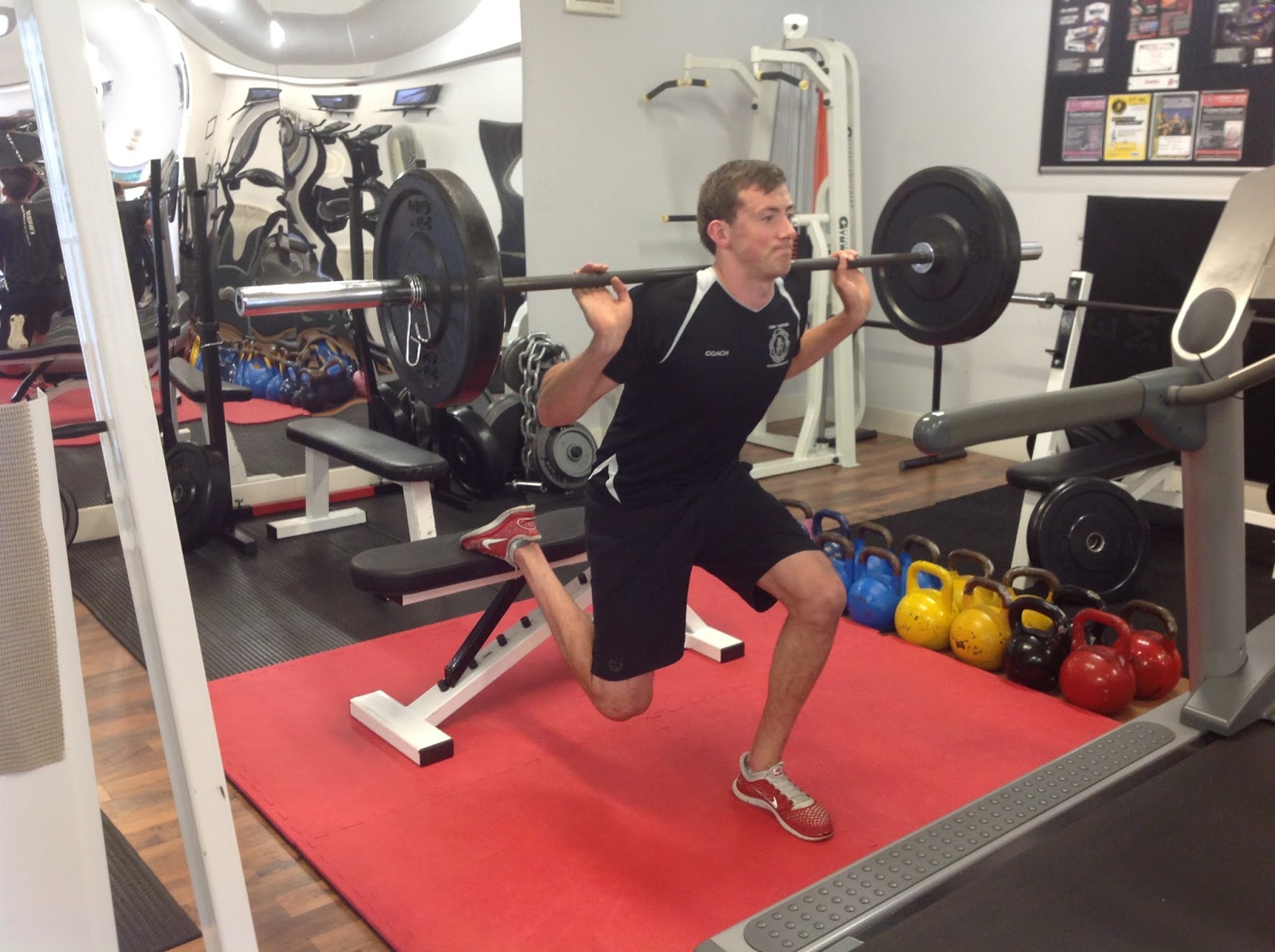
both of these exercises are great for single leg strength and should be practiced regularly throughout your strength and conditioning programme.
Thursday, May 16, 2013
Friday, February 8, 2013
Balls for thought
The Exercise Ball
Where did the exercise ball come from?
The Swiss Ball was originally practiced in an orthopedic medicine and physical therapy clinic founded by Swiss doctor Susan Klein-Vogelbach and used as a form of rehabilitation. From there, the concept of ball exercises was taken from Europe to America by Joanne-Posner-Mayer in the late ‘80s and she was the first to promote the exercise ball in the fitness industry. As of today, many fitness professionals are promoting the use of the exercise ball as well as athletes from a variety of sports at every level, who are incorporating ball exercises into their training regimen.
Exercise balls now come in a variety of sizes and are often used alongside other fitness equipment such as dumbbells to enhance work outs.
So what are the benefits of using an exercise ball?
The biggest benefit of using an exercise ball is its ability to strengthen core muscles. When exercising using the ball, you’re abdominal and back muscles are working constantly to keep you balanced. Even if you are targeting a different area of the body you’re core muscles are still engaged so they are still getting a work out. Also by toning your core muscles, this can greatly improve your posture as your core muscles keep working after exercise and this helps you to sit up or stand straight. As well as improve your posture, using an exercise ball can increase your flexibility. The ball enables you to stretch your body further than it is normally used to whilst providing you with support, making it a safer way to stretch and this is why physiotherapists swear by these exercise balls.
What should you do when using the exercise ball?
As with any other type of exercise, carrying out a warm up is essential. This will raise the heart rate and warm the muscles up which will prevent injuries occurring. A warm up will also get you mentally prepared for the physical activity ahead. Also, it is important especially when using the exercise ball that you maintain posture- keeping your back straight and preventing your knees from locking during exercise. Finally, you should focus on breathing- inhaling when going into the exercise and exhaling at the point of exertion.
What exercises that can be done using the exercise ball?
There are an endless number of exercises which can be done using the ball. Here are just a few. These can be repeated 3 sets of 5 reps if you are a beginner, 3 sets of 10 reps if you’re at an intermediate stage and 3 sets of 20 reps if you are advanced.
Back Extensions
- Start by lying face down over the ball with the top of the ball under your waistline, hands resting lightly on the floor in front of you.
- Feet are shoulder width apart resting on the floor
- Pull your shoulder blades together and slowly raise your chest up off the ball.
- Raise your arms up off the ball keeping your elbows straight and your arms in front of you.
- Lower arms and chest slowly.
Press Ups
- Start by kneeling with the ball in front of you, placing your hands about shoulder width apart on the ball.
- Get up onto your toes and pull your shoulder blades down and back.
- Keep yourself straight from your head to your heels.
- Engage your abdominals to maintain balance.
- Lower your chest to the ball slowly and rise back up keeping body straight.
Tricep Dips
- Stand in front of the ball and lean back, bending your knees.
- Place your hands on the ball behind you and lean into the exercise ball.
- Keep your elbows bent and lower yourself down toward the floor in front of the ball.
- Slowly return to the starting position.
Plank
- Kneel on the floor in front of the ball and slide forward so that you are lying over the ball with the ball situated under your feet and your arms straight.
- Your hands should be directly under your shoulders
- You should be looking down at the floor, chin tucked in
- Contract your abdominals so that your back remains straight.
- Hold this position without sagging, shaking or allowing your chin to sink to the floor.
Knee Tuck
- Start in the plank position above.
- Roll the ball forward to bring your knees under your hips.
Keep elbows straight.
- Slowly roll the exercise ball back to the plank position.
Lunge
- Stand with your back to the exercise ball.
- Raise one foot back and place it on the ball.
- Put your hands on your hips and lower yourself until your thigh is horizontal.
- Raise yourself back up to the starting position.
Kerry Timmins
(Work experience)
West Lothian College
Tuesday, October 9, 2012
Friday, September 7, 2012
The Rotator Cuff

The rotator cuff is a very important group of muscles found in the back of the shoulder coming from the shoulder blade to the shoulder joint. They are important for posture, stability and movement of the shoulder and comprise of the teres minor, infraspinatus, supraspinatus and subscapularis.
A lot of injuries occur due to ignorance of these four muscles and any athletes or gym goers should become familiar with them not just to prevent shoulder injuries but to increase performance too. If you are looking to do any sort of isolation exercises then it should be rotator cuff exercises.
Good shoulder health will help performance in other exercises and sports from bench press to tennis. Working the rotator cuff will strengthen the shoulder girdle making it more stable and will aid anyone looking to lift more on the bench, shoulder press and other upper body exercises. It will also improve posture especially with those who have over worked the ‘mirror muscles’ thus improving rounding of the shoulders making the shoulders look wider and giving a bigger V shape as it helps to bring the shoulders back to their natural position.
Also along with improvements in shoulder stability exercising the rotator cuff will improve flexibility in the shoulder helping golfers, tennis players, javelin and most other team sports and individual sports where shoulder movements are demanding. Maintaining a flexible shoulder joint allows for greater range of movement over the joint therefore it can improve force whilst preventing injury.
Exercises for the rotator cuff are varied try these to take your body to the next level:
Swiss ball press up – place your hands on the Swiss ball shoulder width apart and take up the press up position, lower chest to ball keeping shoulders, hips and ankles in line then raise again.
Lateral Raise – holding dumbbells, if required, stand with arms by the sides thumbs facing body and palms facing backwards. Raise arms to shoulder level keeping pinkie finger facing the sky and thumb facing the ground then lower back to sides.
Lying Rotator Roll – lying on one side hold a dumbbell in hand of side facing ceiling, bend arm at elbow to ninety degrees and have wrist across front. Rotate arm at shoulder bringing hand up towards ceiling and keeping elbow in at side then lower.
Daniel
Personal Trainer
Tuesday, May 29, 2012
Core Strength

Friday, February 17, 2012
Plyometrics
Plyometric: Bounce Ability
To start with what is plyometric; the main idea behind it is to force the body to exert the greatest amount of force possible, in the shortest time possible from any chosen muscle group. To therefore repeat this action continuously.
Plyometric exercises are more dominantly used with top sports man and woman needing that explosive power, though more and more people are using them in general day to day programmes. Depending on a person’s fitness goals will determine whether or not plyometric will be of full benefit.
Plyometric Benefits
+ Endurance
For most increasing fitness is one of the key areas they like to improve, with plyometric training it allows a greater endurance allowing an athlete or novice to perform at a higher level for longer.
+ Muscle Strength
Another big feature for most is bulking up or becoming stronger, with plyometric exercises lean muscle is developed far greater providing an athlete with stronger and more efficient muscles.
+ Calorie Burn
The big one for most calories burning, due to the intensity of the exercise it enhances your metabolic rate allowing for higher calorie burn.
+ Injury risk reduced
Due to the extent of the training, plyometric training allows greater motion within the joints improving flexibility and providing muscle strength which reduces the risk of injury.
Plyometric training is endless with the different variations to each exercise and provides endless benefits for the participant. To get started try the most common the box jump, enjoy and bounce your way to success.
Box Jump
One of the most recognisable plyometric exercises is the box jump, as it involves the participant to exert the maximum force possible from the legs to jump on top of a box, landing with two feet. Though other kit could be used such a gym bench or even steps depending on how hard you want the jump. Go on give it go.
David Low
Personal Trainer
Saturday, November 26, 2011
members comments
Below are some of the comments from our members since opening in June this year. All comments can be viewed by visiting us @ Fit Inc, studio, gym and dojo West Lothian's Premier Training Centre.
Great help from Wullie and Dave, Good guys very helpful
Robert, Polbeth
Fab street gym with big wullie, learned some new stuff, Thanks
Audrey, newbrudge
Brilliant kickboxing tonight, Thank You Brian
Morag Pumpherstoun
Ann you are legend!
Dizzi Kirkliston
Thanks Brian Feel like I'm dying, another good street gym
Kim Bathgate
Brilliant class Ritchie, beasting us as per
Tracey, Livingston
Quality Circuits
Leo, Livingston
T.O.D Combat the only way to reach peak fitness, awesome training
Craig, Kuk sool won Dunfermline
Military Training? doesnt feel it but it's worth it
Gordon, Currie Edinburgh
Fab workout, Matthew your the biz
Ann Broxburn
Military Training = Pain but very good
Mark, Bathgate
First time back at spin for two weeks, FAB cheers Dave
Carol Livingston
Run club 5.8 miles good fun cheers Lucy
Angela, Livingston
Great core complex class, thanks Ryan
Jenny, Dedridge
Great spin class dave
Lorraine, Livingston
loved the Ton up class, could be longer than 30 minutes thanks David
Tina, Howden
Julianna thanks for the class and and tips
Carol, Murieston
fabby induction by the boss
Karen, Livingston
showers amazing, poles at street gym are a nightmare
Linda howden
loving body pump and getting used to run club
Carol, Livingston
core complex and hells bells great class
Martin, Pumpherstoun
ladies kickboxing, love it
Sharon, Kirknewton
Great help from Wullie and Dave, Good guys very helpful
Robert, Polbeth
Fab street gym with big wullie, learned some new stuff, Thanks
Audrey, newbrudge
Brilliant kickboxing tonight, Thank You Brian
Morag Pumpherstoun
Ann you are legend!
Dizzi Kirkliston
Thanks Brian Feel like I'm dying, another good street gym
Kim Bathgate
Brilliant class Ritchie, beasting us as per
Tracey, Livingston
Quality Circuits
Leo, Livingston
T.O.D Combat the only way to reach peak fitness, awesome training
Craig, Kuk sool won Dunfermline
Military Training? doesnt feel it but it's worth it
Gordon, Currie Edinburgh
Fab workout, Matthew your the biz
Ann Broxburn
Military Training = Pain but very good
Mark, Bathgate
First time back at spin for two weeks, FAB cheers Dave
Carol Livingston
Run club 5.8 miles good fun cheers Lucy
Angela, Livingston
Great core complex class, thanks Ryan
Jenny, Dedridge
Great spin class dave
Lorraine, Livingston
loved the Ton up class, could be longer than 30 minutes thanks David
Tina, Howden
Julianna thanks for the class and and tips
Carol, Murieston
fabby induction by the boss
Karen, Livingston
showers amazing, poles at street gym are a nightmare
Linda howden
loving body pump and getting used to run club
Carol, Livingston
core complex and hells bells great class
Martin, Pumpherstoun
ladies kickboxing, love it
Sharon, Kirknewton
Subscribe to:
Posts (Atom)