S-“I haven’t trained in 8 months owing to a double ITB problem as in both legs have been written off by the physio”
Me- “So you need a rehab programme to get you on the mend before you start training for your 5k events”
S- “kinda, I want to run a marathon”
B- “okay no problem when are you looking at”
S- “That’s the dilemma”
B-“Why”?
S-“It’s the Jersey marathon and it is in six weeks”
B- “oh”
So based on that we discussed the challenge and despite trying to persuade her to wait a while, we started the programme.
Sarah posted 4hours 45 minutes for her first attempt which given the injury and time period for training was a great effort.
From there a relationship between Coach and athlete grew, with Sarah coming up with more little goals in between her main goals. Remembering her only goal was to do 1 marathon, in her first year we completed three marathons and a number of 5 and 10k events with a half marathon for good measure.
Year 2 was the laughable one “I will just concentrate on half marathons this year”, that lasted all of two minutes when I heard “Will you train me for an ultra”? (An ultra marathon being any distance beyond marathon distance.)
The good thing was Sarah trusted me with regard to her training and despite many of her peers and fellow runners telling her it was all wrong, “runners don’t train like that” we kept going.
Sarah was introduced to Olympic lifting, kettlebells, sledges, trx, tyres, weight vests, hypoxic training, TUF (technique under fatigue) and so much more. Her running style and programme completely changed introducing hill reps, sprints, working the curve in reverse doing speed power then endurance. Most of all she was asked for constant feedback which was something new to her!
Sarah forms part of our Athlete performance programmae and has kindly given a testimonial which can be read below—

Running a marathon was an ultimate goal. It scared the hell out of me but I wanted to try it just once. Sure, I could have downloaded a training programme from the internet but I knew I needed a bit more of a ‘push’ – and I had a few wee injury niggles to resolve. I needed some help with this challenge.
Having trained previously as part of a group instructed by Brian, I knew he had the mix of knowledge and motivational skills that would get me through. And he did. There was only one ‘problem’.
He made this and other challenges seem achievable. It seemed logical after a few marathons to look to other challenges and I wondered how far I could go, could I complete an ultra marathon? After my first 53 mile race, we found out – yes, I could. My goals change and evolve because I gain physical strength and mental confidence from training with Brian.
We have now completed two competitive years and I have had no injuries to hamper my training. Yes, training can be hard work sometimes but he also makes it fun too and the results are worth it. Brian makes me realise I can achieve more than I ever thought I could.
Her strength exercises consisted of the following basics, with a variety of others at different stages of the programme.
Clean and Press


Reason
The exercise involves strength and speed and works the deltoids, trapezius, quadriceps, hamstrings, glutes and triceps.
Deadlift


Another strength and speed exercise targeting the lower back trapezius, quads, hamstrings and glutes
Squats
Picture to follow
The squats are a great strength exercise and target the quads, hamstrings, hips and lower back
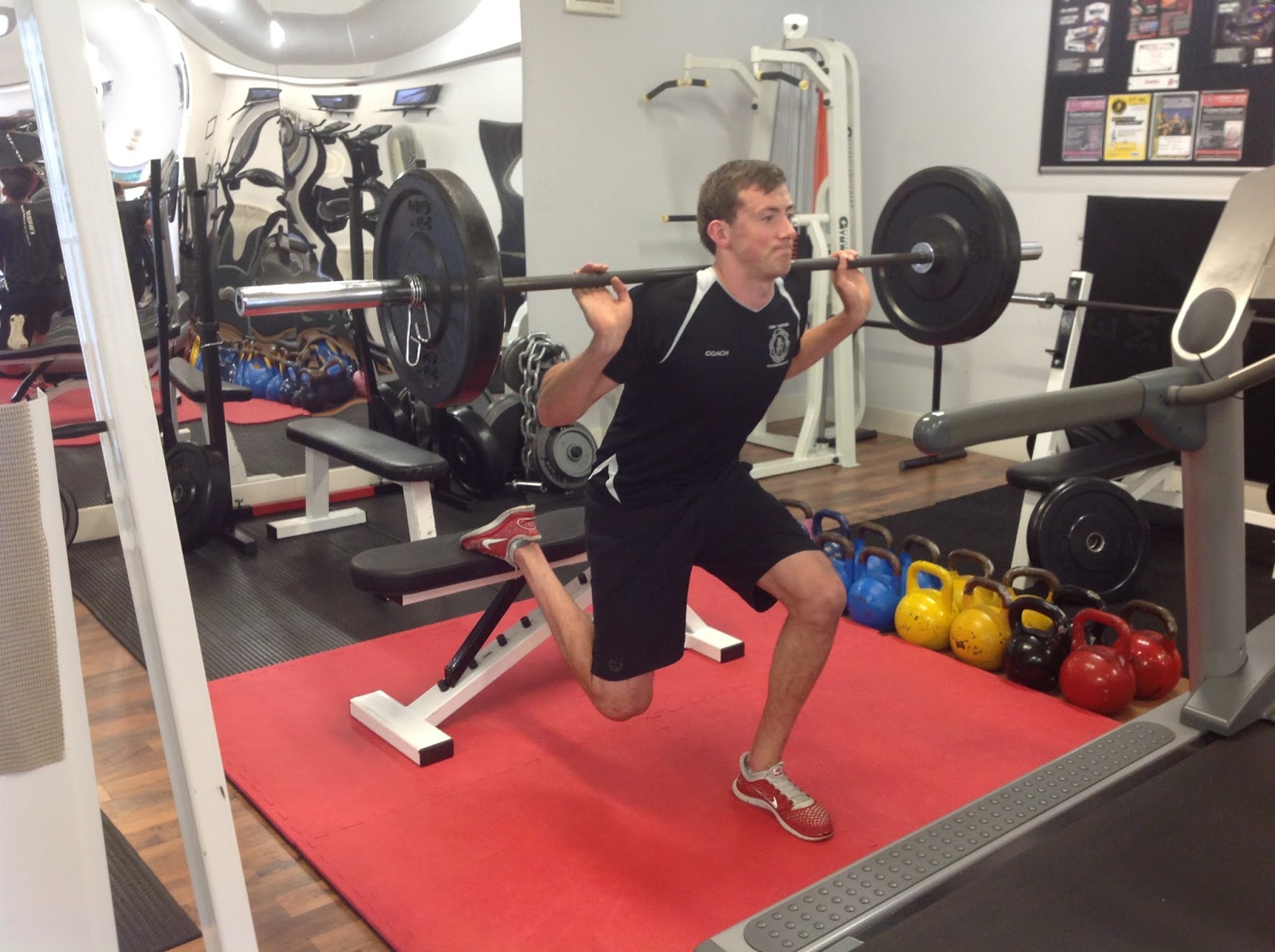
Sissy lunges


This exercise - a variety of a standard lunge - is not vastly used but is great for strengthening the vastus medialis muscle which helps to align and track the kneecap properly. If you strengthen this muscle it can help prevent runners knee/knee pain.
Charlies Angels
A variety of the Gun drill exercise


Plyometric exercise aids running economy and all runners should incorporate single leg exercises into their programme, the additional benefit of this type of jumping lunge is the rotation of the torso which helps promote stability in the abdominal and lower back areas.
Kettlebell swing


The kettlebell swing is both a strength and power exercise. The swing strengthens the back, shoulders, torso and posterior kinetic chain, It also promotes functionality of the body as in it works as one unit rather than isolating the muscle groups.
Kettlebell single leg deadlift


Targets the posterior chain and torso , inclusive of hamstring, glutes and erector spinae which help with posture , which are also involved in running, and jumping, they are responsible for generating hip and back extension power. Aside from the performance and posture promotion, keeping these muscles in good shape is also important for injury prevention.
Since the initial programme Sarah has competed in over 13 ultra marathons (ranging in distance from 33 miles to 95 miles), marathons, duathlons, x country events and is one of only five women in Scotland to have completed five ultra races in the 2013 Scottish Ultra Marathon Series.
What will next season bring?