Wednesday, February 11, 2015
Certified kettlebell Instructor course
This unique concentrated one day course is certified by CMA and SFO UK and has been awarded 10 CPD points. The course requires pre study prior to attending. Course cost is only £129.
Our course delivers all the concepts that you as a newly qualified instructor will need to take your training or clients training to the next level.
The course covers all the major concepts of Kettlebell training and variations of them
The swing
The snatch
Clean and press
Squat
Deadlifts
Military press
TGU,s
Full documented manual covering the whole course.
And much more.............
To book your place please contact us via email at todcoaching@btinternet.com.
Women and Weight Training
By
Juliana Dorman, Personal Trainer and Nutritional Coach at T.O.D Coaching, Fit inc Studio gym
In my role as personal trainer, when taking on a new female client I often come across the same fears and comments at the point of assessment for their programme.
Women want to look good. They want the pert butt, the flat abs and the toned arms, legs and body just as much as any man who goes to the gym and lifts weights.
Will a guy look good if he follows a weight training programme, and follow a healthy diet? Eh yeah, so why does a woman come to the gym thinking that they will look like a bikini model if they run on the treadmill for and hour a day?
Why women don't want to lift weights
Usually a female client will tell me, " but I don't want big muscles! I don't want to look like Arnie", well I can assure you, if it was that easy to look like Mr Swarzenegger, everyone would go around looking buff! It is physiologically impossible for a woman to put on large amounts of muscle mass; their body's hormonal makeup is not one that will allow it to do so.
The hormone testosterone is responsible for the large increases in muscle mass seen when men lift weights. Women’s testosterone levels are a fraction of men’s testosterone levels. Normal testosterone levels in men are 200-1200 ng/dl while 15-70 ng/dl are normal in women. As you can see, men’s testosterone levels are SIGNIFICANTLY higher than women’s. Even if a man is at the LOW end of the men’s normal testosterone range (200 ng/dl), he still has more than twice the amount of testosterone as a woman at the HIGH end of the women’s normal testosterone range (70 ng/dl).
Over the last decade, research shows the benefits of weight training for women and especially those over the age of forty. Apart from the aesthetics of looking good and being toned, weight training, or any type of resistance training is important for women, this is because any type of resistance training increases bone density. Women over the age of 40 are at increased risk of osteoporosis due to decreasing oestrogen. Many think that taking calcium supplements will stop osteoporosis, but with the absence of oestrogen the body cannot carry out the processes required to use the calcium to strengthen the bones.
Most women who exercise are spending most of their gym time on cardiovascular exercise, and less time using resistance that challenges their bodies.
Research & Studies
Studies have shown that men and women do not need to train differently.
If you are a woman and want to gain muscle and improve your shape and curves, then you are going to have to lift heavy weights.
Diet & Nutrition
Men and women do not need to train differently to see results, but what about diet? Should women eat differently than men? Not really. Men’s and women’s metabolisms are very similar except, interestingly enough, that women burn a greater ratio of fat to carbs than men. This may be one of the reasons women do well on lower carb diets. The main thing that needs to be adjusted is total calorie intake. Women need fewer calories than men because men have more muscle mass and less fat (relative to total bodyweight) than women. The amount of protein, carbs, and fat will be dictated by the amount of calories eaten.
It has been shown that women do not need to train or diet much differently than men. So ladies please stop doing hours of cardio and lifting the lightest dumbbells in the gym for endless reps!
Rather than ask for advice, women will be misinformed (by the media), about how women should train. What about diet? One of the most common breakfast meals recommended to women is yogurt and a banana. Now there is nothing wrong with eating a yogurt and banana, but where is the protein and essential fatty acids? If you are a woman trying to gain lean muscle, you will need to eat adequate protein and good fats (essential fatty acids). It is time to stop listening to the media and misinformed individuals and time to become educated and get results.
Dieting for Women — General Guidelines
Before we get into the recommended diets for women trying to lose fat and gain lean muscle, let’s go over some general diet guidelines.
Calorie Control
The biggest factor in a diet is calories in versus calories out; your total calories will determine if you lose or gain weight. Eating too many calories will lead to fat gain. But if you don’t eat enough calories you will not gain lean muscle. Setting a target calorie intake and counting the amount of calories you eat each day is vital to losing fat and gaining lean muscle.
Macronutrient Manipulation
While your total caloric intake is the most important diet factor, the ratio of protein to carbs to fat can dictate whether the weight you gain/lose is muscle or fat. A diet that contains 80% of calories from carbs, 10% from protein, and 10% from fat will produce different results than a diet containing 40% of calories from carbs, 40% from protein, and 20% from fat. This is very important and will come down to your body type.
Stay Hydrated
You should drink plenty of water every day. The benefits drinking water provides are optimal hydration as well as a feeling of “fullness” without added calories. Sometimes people will mistake thirst for hunger. Because of this, staying hydrated can also prevent overeating.
Quality Control
Choose fresh, wholesome foods over pre-packaged, processed foods. Packaged foods are loaded with preservatives, especially sodium and saturated fats, and often have high amounts of sugars, such as high fructose corn syrup.
You will be amazed at how fast you can lose fat just by packing meals from home rather than purchasing fast food or packaged foods. You also will save a lot of money!
Insulin Control
Insulin is the “storage” hormone. When it is secreted fat burning is blunted. By controlling insulin secretion by choosing low GI carbs you can decrease fat gain/increase fat loss. Stable blood sugar levels also improve energy levels and ones mood. All of our diets as based around insulin control, leading to leaner muscle gains with little to no fat gain.
Adequate Protein
In order to gain lean muscle you need to eat enough protein to sustain the creation of new muscle proteins. You may not be used to eating the amount of protein required to gain muscle, but an increase in your protein, and having lean protein with every meal, is a good starting point.
Essential Fats
Essential fatty acids (EFAs) are vital to the proper functioning on your body. EFAs are needed by the body and are part of a healthy diet. Eating fats does not equate to getting fat. In fact, most EFAs help support the fat burning process and maintaining a lean body. Do not be scared to eat good fats. EFAs are not the enemy.
So have I managed to convince you????
See you at the weights section in the gym :)
By
Juliana Dorman, Personal Trainer and Nutritional Coach at T.O.D Coaching, Fit inc Studio gym
In my role as personal trainer, when taking on a new female client I often come across the same fears and comments at the point of assessment for their programme.
Women want to look good. They want the pert butt, the flat abs and the toned arms, legs and body just as much as any man who goes to the gym and lifts weights.
Will a guy look good if he follows a weight training programme, and follow a healthy diet? Eh yeah, so why does a woman come to the gym thinking that they will look like a bikini model if they run on the treadmill for and hour a day?
Why women don't want to lift weights
Usually a female client will tell me, " but I don't want big muscles! I don't want to look like Arnie", well I can assure you, if it was that easy to look like Mr Swarzenegger, everyone would go around looking buff! It is physiologically impossible for a woman to put on large amounts of muscle mass; their body's hormonal makeup is not one that will allow it to do so.
The hormone testosterone is responsible for the large increases in muscle mass seen when men lift weights. Women’s testosterone levels are a fraction of men’s testosterone levels. Normal testosterone levels in men are 200-1200 ng/dl while 15-70 ng/dl are normal in women. As you can see, men’s testosterone levels are SIGNIFICANTLY higher than women’s. Even if a man is at the LOW end of the men’s normal testosterone range (200 ng/dl), he still has more than twice the amount of testosterone as a woman at the HIGH end of the women’s normal testosterone range (70 ng/dl).
Over the last decade, research shows the benefits of weight training for women and especially those over the age of forty. Apart from the aesthetics of looking good and being toned, weight training, or any type of resistance training is important for women, this is because any type of resistance training increases bone density. Women over the age of 40 are at increased risk of osteoporosis due to decreasing oestrogen. Many think that taking calcium supplements will stop osteoporosis, but with the absence of oestrogen the body cannot carry out the processes required to use the calcium to strengthen the bones.
Most women who exercise are spending most of their gym time on cardiovascular exercise, and less time using resistance that challenges their bodies.
Research & Studies
Studies have shown that men and women do not need to train differently.
If you are a woman and want to gain muscle and improve your shape and curves, then you are going to have to lift heavy weights.
Diet & Nutrition
Men and women do not need to train differently to see results, but what about diet? Should women eat differently than men? Not really. Men’s and women’s metabolisms are very similar except, interestingly enough, that women burn a greater ratio of fat to carbs than men. This may be one of the reasons women do well on lower carb diets. The main thing that needs to be adjusted is total calorie intake. Women need fewer calories than men because men have more muscle mass and less fat (relative to total bodyweight) than women. The amount of protein, carbs, and fat will be dictated by the amount of calories eaten.
It has been shown that women do not need to train or diet much differently than men. So ladies please stop doing hours of cardio and lifting the lightest dumbbells in the gym for endless reps!
Rather than ask for advice, women will be misinformed (by the media), about how women should train. What about diet? One of the most common breakfast meals recommended to women is yogurt and a banana. Now there is nothing wrong with eating a yogurt and banana, but where is the protein and essential fatty acids? If you are a woman trying to gain lean muscle, you will need to eat adequate protein and good fats (essential fatty acids). It is time to stop listening to the media and misinformed individuals and time to become educated and get results.
Dieting for Women — General Guidelines
Before we get into the recommended diets for women trying to lose fat and gain lean muscle, let’s go over some general diet guidelines.
Calorie Control
The biggest factor in a diet is calories in versus calories out; your total calories will determine if you lose or gain weight. Eating too many calories will lead to fat gain. But if you don’t eat enough calories you will not gain lean muscle. Setting a target calorie intake and counting the amount of calories you eat each day is vital to losing fat and gaining lean muscle.
Macronutrient Manipulation
While your total caloric intake is the most important diet factor, the ratio of protein to carbs to fat can dictate whether the weight you gain/lose is muscle or fat. A diet that contains 80% of calories from carbs, 10% from protein, and 10% from fat will produce different results than a diet containing 40% of calories from carbs, 40% from protein, and 20% from fat. This is very important and will come down to your body type.
Stay Hydrated
You should drink plenty of water every day. The benefits drinking water provides are optimal hydration as well as a feeling of “fullness” without added calories. Sometimes people will mistake thirst for hunger. Because of this, staying hydrated can also prevent overeating.
Quality Control
Choose fresh, wholesome foods over pre-packaged, processed foods. Packaged foods are loaded with preservatives, especially sodium and saturated fats, and often have high amounts of sugars, such as high fructose corn syrup.
You will be amazed at how fast you can lose fat just by packing meals from home rather than purchasing fast food or packaged foods. You also will save a lot of money!
Insulin Control
Insulin is the “storage” hormone. When it is secreted fat burning is blunted. By controlling insulin secretion by choosing low GI carbs you can decrease fat gain/increase fat loss. Stable blood sugar levels also improve energy levels and ones mood. All of our diets as based around insulin control, leading to leaner muscle gains with little to no fat gain.
Adequate Protein
In order to gain lean muscle you need to eat enough protein to sustain the creation of new muscle proteins. You may not be used to eating the amount of protein required to gain muscle, but an increase in your protein, and having lean protein with every meal, is a good starting point.
Essential Fats
Essential fatty acids (EFAs) are vital to the proper functioning on your body. EFAs are needed by the body and are part of a healthy diet. Eating fats does not equate to getting fat. In fact, most EFAs help support the fat burning process and maintaining a lean body. Do not be scared to eat good fats. EFAs are not the enemy.
So have I managed to convince you????
See you at the weights section in the gym :)
Saturday, March 8, 2014
Tuesday, February 18, 2014
Tuesday, January 7, 2014
Wednesday, November 6, 2013
Strength training for runners
Sarah Robertson came to me a few years ago with dilemma and a challenge, having only been a 5k runner for a number of years, the initial consultation went along these lines:
S-“I haven’t trained in 8 months owing to a double ITB problem as in both legs have been written off by the physio”
Me- “So you need a rehab programme to get you on the mend before you start training for your 5k events”
S- “kinda, I want to run a marathon”
B- “okay no problem when are you looking at”
S- “That’s the dilemma”
B-“Why”?
S-“It’s the Jersey marathon and it is in six weeks”
B- “oh”
So based on that we discussed the challenge and despite trying to persuade her to wait a while, we started the programme.
Sarah posted 4hours 45 minutes for her first attempt which given the injury and time period for training was a great effort.
From there a relationship between Coach and athlete grew, with Sarah coming up with more little goals in between her main goals. Remembering her only goal was to do 1 marathon, in her first year we completed three marathons and a number of 5 and 10k events with a half marathon for good measure.
Year 2 was the laughable one “I will just concentrate on half marathons this year”, that lasted all of two minutes when I heard “Will you train me for an ultra”? (An ultra marathon being any distance beyond marathon distance.)
The good thing was Sarah trusted me with regard to her training and despite many of her peers and fellow runners telling her it was all wrong, “runners don’t train like that” we kept going.
Sarah was introduced to Olympic lifting, kettlebells, sledges, trx, tyres, weight vests, hypoxic training, TUF (technique under fatigue) and so much more. Her running style and programme completely changed introducing hill reps, sprints, working the curve in reverse doing speed power then endurance. Most of all she was asked for constant feedback which was something new to her!
Sarah forms part of our Athlete performance programmae and has kindly given a testimonial which can be read below—

Running a marathon was an ultimate goal. It scared the hell out of me but I wanted to try it just once. Sure, I could have downloaded a training programme from the internet but I knew I needed a bit more of a ‘push’ – and I had a few wee injury niggles to resolve. I needed some help with this challenge.
Having trained previously as part of a group instructed by Brian, I knew he had the mix of knowledge and motivational skills that would get me through. And he did. There was only one ‘problem’.
He made this and other challenges seem achievable. It seemed logical after a few marathons to look to other challenges and I wondered how far I could go, could I complete an ultra marathon? After my first 53 mile race, we found out – yes, I could. My goals change and evolve because I gain physical strength and mental confidence from training with Brian.
We have now completed two competitive years and I have had no injuries to hamper my training. Yes, training can be hard work sometimes but he also makes it fun too and the results are worth it. Brian makes me realise I can achieve more than I ever thought I could.
Her strength exercises consisted of the following basics, with a variety of others at different stages of the programme.
Clean and Press


Reason
The exercise involves strength and speed and works the deltoids, trapezius, quadriceps, hamstrings, glutes and triceps.
Deadlift


Another strength and speed exercise targeting the lower back trapezius, quads, hamstrings and glutes
Squats
Picture to follow
The squats are a great strength exercise and target the quads, hamstrings, hips and lower back
Sissy lunges

This exercise - a variety of a standard lunge - is not vastly used but is great for strengthening the vastus medialis muscle which helps to align and track the kneecap properly. If you strengthen this muscle it can help prevent runners knee/knee pain.
Charlies Angels
A variety of the Gun drill exercise


Plyometric exercise aids running economy and all runners should incorporate single leg exercises into their programme, the additional benefit of this type of jumping lunge is the rotation of the torso which helps promote stability in the abdominal and lower back areas.
Kettlebell swing


The kettlebell swing is both a strength and power exercise. The swing strengthens the back, shoulders, torso and posterior kinetic chain, It also promotes functionality of the body as in it works as one unit rather than isolating the muscle groups.
Kettlebell single leg deadlift


Targets the posterior chain and torso , inclusive of hamstring, glutes and erector spinae which help with posture , which are also involved in running, and jumping, they are responsible for generating hip and back extension power. Aside from the performance and posture promotion, keeping these muscles in good shape is also important for injury prevention.
Since the initial programme Sarah has competed in over 13 ultra marathons (ranging in distance from 33 miles to 95 miles), marathons, duathlons, x country events and is one of only five women in Scotland to have completed five ultra races in the 2013 Scottish Ultra Marathon Series.
What will next season bring?
S-“I haven’t trained in 8 months owing to a double ITB problem as in both legs have been written off by the physio”
Me- “So you need a rehab programme to get you on the mend before you start training for your 5k events”
S- “kinda, I want to run a marathon”
B- “okay no problem when are you looking at”
S- “That’s the dilemma”
B-“Why”?
S-“It’s the Jersey marathon and it is in six weeks”
B- “oh”
So based on that we discussed the challenge and despite trying to persuade her to wait a while, we started the programme.
Sarah posted 4hours 45 minutes for her first attempt which given the injury and time period for training was a great effort.
From there a relationship between Coach and athlete grew, with Sarah coming up with more little goals in between her main goals. Remembering her only goal was to do 1 marathon, in her first year we completed three marathons and a number of 5 and 10k events with a half marathon for good measure.
Year 2 was the laughable one “I will just concentrate on half marathons this year”, that lasted all of two minutes when I heard “Will you train me for an ultra”? (An ultra marathon being any distance beyond marathon distance.)
The good thing was Sarah trusted me with regard to her training and despite many of her peers and fellow runners telling her it was all wrong, “runners don’t train like that” we kept going.
Sarah was introduced to Olympic lifting, kettlebells, sledges, trx, tyres, weight vests, hypoxic training, TUF (technique under fatigue) and so much more. Her running style and programme completely changed introducing hill reps, sprints, working the curve in reverse doing speed power then endurance. Most of all she was asked for constant feedback which was something new to her!
Sarah forms part of our Athlete performance programmae and has kindly given a testimonial which can be read below—

Running a marathon was an ultimate goal. It scared the hell out of me but I wanted to try it just once. Sure, I could have downloaded a training programme from the internet but I knew I needed a bit more of a ‘push’ – and I had a few wee injury niggles to resolve. I needed some help with this challenge.
Having trained previously as part of a group instructed by Brian, I knew he had the mix of knowledge and motivational skills that would get me through. And he did. There was only one ‘problem’.
He made this and other challenges seem achievable. It seemed logical after a few marathons to look to other challenges and I wondered how far I could go, could I complete an ultra marathon? After my first 53 mile race, we found out – yes, I could. My goals change and evolve because I gain physical strength and mental confidence from training with Brian.
We have now completed two competitive years and I have had no injuries to hamper my training. Yes, training can be hard work sometimes but he also makes it fun too and the results are worth it. Brian makes me realise I can achieve more than I ever thought I could.
Her strength exercises consisted of the following basics, with a variety of others at different stages of the programme.
Clean and Press


Reason
The exercise involves strength and speed and works the deltoids, trapezius, quadriceps, hamstrings, glutes and triceps.
Deadlift


Another strength and speed exercise targeting the lower back trapezius, quads, hamstrings and glutes
Squats
Picture to follow
The squats are a great strength exercise and target the quads, hamstrings, hips and lower back
Sissy lunges

This exercise - a variety of a standard lunge - is not vastly used but is great for strengthening the vastus medialis muscle which helps to align and track the kneecap properly. If you strengthen this muscle it can help prevent runners knee/knee pain.
Charlies Angels
A variety of the Gun drill exercise


Plyometric exercise aids running economy and all runners should incorporate single leg exercises into their programme, the additional benefit of this type of jumping lunge is the rotation of the torso which helps promote stability in the abdominal and lower back areas.
Kettlebell swing


The kettlebell swing is both a strength and power exercise. The swing strengthens the back, shoulders, torso and posterior kinetic chain, It also promotes functionality of the body as in it works as one unit rather than isolating the muscle groups.
Kettlebell single leg deadlift


Targets the posterior chain and torso , inclusive of hamstring, glutes and erector spinae which help with posture , which are also involved in running, and jumping, they are responsible for generating hip and back extension power. Aside from the performance and posture promotion, keeping these muscles in good shape is also important for injury prevention.
Since the initial programme Sarah has competed in over 13 ultra marathons (ranging in distance from 33 miles to 95 miles), marathons, duathlons, x country events and is one of only five women in Scotland to have completed five ultra races in the 2013 Scottish Ultra Marathon Series.
What will next season bring?
Labels:
10k,
5k,
athlete,
coaching,
combat,
conditioning,
distance,
exercises,
fit,
fun,
inc,
marathons,
performance,
running,
strength,
ultra,
west highland way
Tuesday, September 10, 2013
GB Athlete Jenny Douglas @T.O.D Coaching
Thursday, July 18, 2013
Friday, July 5, 2013
Strength and conditioning for triathlon part two
in the last issue we looked at two forms of squats, this issue we will look at two more types of leg exercise, namely the step up and bulgarian split squats. Both exercises re great single leg exercises for developing strentgh.
The Step Up
Ensure that the box used for this exercise is
> 12-18" minimum off the floor
> or at least high enough to create a right angle on the knee bend non
> slip surface on the top wide enough for the lifters foot to be placed
> fully on top
> Ensure that the bar is approximately armpit height, move towards the bar and place the bar in the low or high position across the back, hips and feet should be directly below the bar.
> a pronated grip approximately more than shoulder width should be adopted.
> elbows should be raised to form a shelf to be created across the back
> so the bar does not slip
> step up onto the box from a standing position with the lead leg, ensure the trail leg is in contact with the floor.
> do not push off the trail leg, ensure that your torso is square and erect throughout the exercise.
> pause at the top of the exercise and
> then shift your weight back to the trail leg before returning the lead leg back to the start position.
*ensure that a spotter is used throughout the exercise
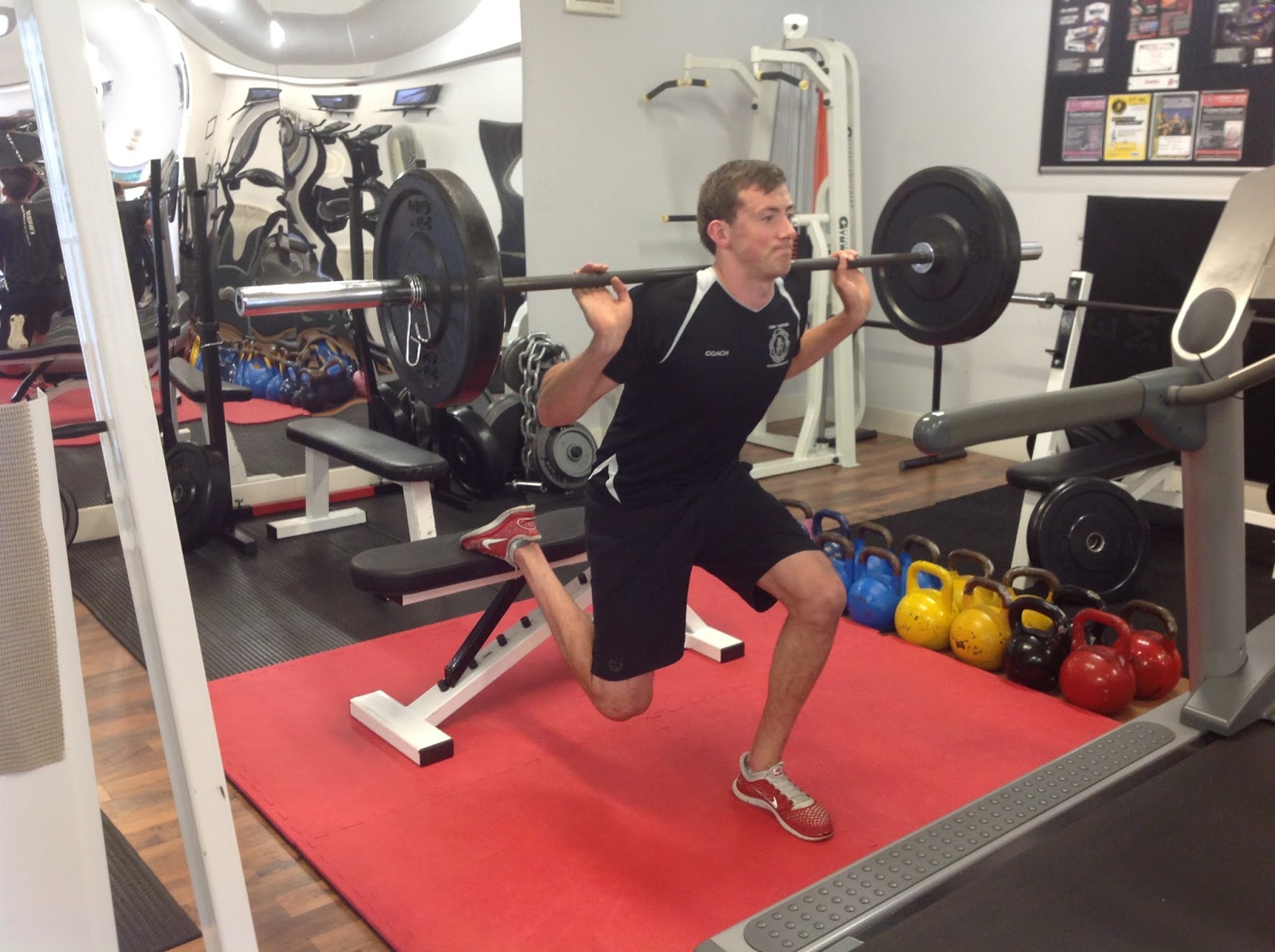
Bulgarian split squats
> grasp the bar in a pronated grip and the bar is in the low or high position across the back, grip should be just outside shoulder width apart.
> stand in front of a bench or box and place the rear foot on the bench
> Ensure that your weight is placed evenly throughout the lead foot with
> the knee in line with your toes
>lower to a point ensuring the the thigh of the lead leg is parallel or
>almost parallel to the floor
> Ensure that the torso remains erect and square to avoid bending over
> the knee should not lock out at the top of the movement.
both of these exercises are great for single leg strength and should be practiced regularly throughout your strength and conditioning programme.
Labels:
duathlon,
endurance,
fit,
inc,
livingston,
strength,
swimming,
triathlon,
west lothian
Thursday, May 16, 2013
Krusty Kreme or the gym
It happens every January/February an influx of New Year’s resolution-makers amble in through the doors of their nearest gym in their box-fresh trainers and shiny new Lycra ensembles. Don't get me wrong, I have nothing but respect for anyone who takes up a fitness regime. What makes me seethe is that perennial breed of gym-goer who thinks they will get in shape simply by turning up. Not for them feeling the burn or working up a sweat. Instead they hang around chatting by the water coolers, cluttering up the fitness machines, taking up space in classes whilst never actually doing anything remotely resembling a workout.
What is even more alarming is the fact that Scotland is claimed to have the most unfit, unhealthy occupants in the UK. Why is Scotland not fit? Who is to blame? Why don’t we eat healthy? Do we blame the recession? Or is it sheer laziness? Is it bred in us to be unhealthy?
Maybe the alarming fact that despite the cold snowy weather, Scotland’s capital saw the launch of a new Krispy Kreme Doughnut store which saw around 300 people waiting anxiously for the doors to open at 7am, on Wed 13th Feb. Since the arrival of store 2 weeks on and you’re still experiencing queues at the Hermiston gate store, Lothian and Borders police have been urging motorists to avoid the western side of Edinburgh altogether due to the chaos. Patrol cars are being sent to Hermiston Gait Retail Park daily to try to stop Krispy Kreme customers causing gridlock to avoid mile-long tailbacks backing on to the M8. This broke the company’s record for the first hour sales of any UK store opening. So what is the attraction? Is it the taste of the 16 different flavoured doughnuts or the fact that everyone else is doing it?
Health campaigners said they were appalled at the number of people prepared to wait in their cars to buy the cholesterol-packed snacks and quite rightly so with the average intake of 430kcal in 1 doughnut and a whopping 23 grams of fat if Edinburgh is overweight today then it will certainly be obese by tomorrow.
So what do we do? How can we sort this? The government is looking to bring out new legislation… Fizzy drinks should be taxed, fast food outlets near schools limited and new parents given specific advice on how to feed their children properly to help tackle spiralling levels of obesity. Is this the way forward? Can we do more?
One in four adults in the UK is obese, figures say, a number expected to double by 2050. Doctors fear the obesity crisis is becoming "irresolvable", and are calling for society "as a whole" to act before it becomes irreversible.
So this is a problem for not just one area but for the country as a whole the NHS, government, councils, schools, parents, workplaces as with obesity comes poor health, poor diet, poor fitness. With the commonwealth games just round the corner are we really promoting healthy living, a better nation with Krispy Kreme queues? I long for the day when a local gym makes the headlines for weeks as it’s the new craze and the queues to enter are avoidable to enter!
Theresa Penrice
West Lothian College
Sport and fitness department
(work experience)
swim article in Go Guide
See our latest article in Go Guide magazine
Friday, April 26, 2013
Friday, February 8, 2013
Balls for thought
The Exercise Ball
Where did the exercise ball come from?
The Swiss Ball was originally practiced in an orthopedic medicine and physical therapy clinic founded by Swiss doctor Susan Klein-Vogelbach and used as a form of rehabilitation. From there, the concept of ball exercises was taken from Europe to America by Joanne-Posner-Mayer in the late ‘80s and she was the first to promote the exercise ball in the fitness industry. As of today, many fitness professionals are promoting the use of the exercise ball as well as athletes from a variety of sports at every level, who are incorporating ball exercises into their training regimen.
Exercise balls now come in a variety of sizes and are often used alongside other fitness equipment such as dumbbells to enhance work outs.
So what are the benefits of using an exercise ball?
The biggest benefit of using an exercise ball is its ability to strengthen core muscles. When exercising using the ball, you’re abdominal and back muscles are working constantly to keep you balanced. Even if you are targeting a different area of the body you’re core muscles are still engaged so they are still getting a work out. Also by toning your core muscles, this can greatly improve your posture as your core muscles keep working after exercise and this helps you to sit up or stand straight. As well as improve your posture, using an exercise ball can increase your flexibility. The ball enables you to stretch your body further than it is normally used to whilst providing you with support, making it a safer way to stretch and this is why physiotherapists swear by these exercise balls.
What should you do when using the exercise ball?
As with any other type of exercise, carrying out a warm up is essential. This will raise the heart rate and warm the muscles up which will prevent injuries occurring. A warm up will also get you mentally prepared for the physical activity ahead. Also, it is important especially when using the exercise ball that you maintain posture- keeping your back straight and preventing your knees from locking during exercise. Finally, you should focus on breathing- inhaling when going into the exercise and exhaling at the point of exertion.
What exercises that can be done using the exercise ball?
There are an endless number of exercises which can be done using the ball. Here are just a few. These can be repeated 3 sets of 5 reps if you are a beginner, 3 sets of 10 reps if you’re at an intermediate stage and 3 sets of 20 reps if you are advanced.
Back Extensions
- Start by lying face down over the ball with the top of the ball under your waistline, hands resting lightly on the floor in front of you.
- Feet are shoulder width apart resting on the floor
- Pull your shoulder blades together and slowly raise your chest up off the ball.
- Raise your arms up off the ball keeping your elbows straight and your arms in front of you.
- Lower arms and chest slowly.
Press Ups
- Start by kneeling with the ball in front of you, placing your hands about shoulder width apart on the ball.
- Get up onto your toes and pull your shoulder blades down and back.
- Keep yourself straight from your head to your heels.
- Engage your abdominals to maintain balance.
- Lower your chest to the ball slowly and rise back up keeping body straight.
Tricep Dips
- Stand in front of the ball and lean back, bending your knees.
- Place your hands on the ball behind you and lean into the exercise ball.
- Keep your elbows bent and lower yourself down toward the floor in front of the ball.
- Slowly return to the starting position.
Plank
- Kneel on the floor in front of the ball and slide forward so that you are lying over the ball with the ball situated under your feet and your arms straight.
- Your hands should be directly under your shoulders
- You should be looking down at the floor, chin tucked in
- Contract your abdominals so that your back remains straight.
- Hold this position without sagging, shaking or allowing your chin to sink to the floor.
Knee Tuck
- Start in the plank position above.
- Roll the ball forward to bring your knees under your hips.
Keep elbows straight.
- Slowly roll the exercise ball back to the plank position.
Lunge
- Stand with your back to the exercise ball.
- Raise one foot back and place it on the ball.
- Put your hands on your hips and lower yourself until your thigh is horizontal.
- Raise yourself back up to the starting position.
Kerry Timmins
(Work experience)
West Lothian College
Wednesday, January 30, 2013
Conditiong circuit
Boxing Coach Wille and boxer Stephen with Coach Ann (GI pain)
http://youtu.be/3KKlOXg07ps
Labels:
boxing,
combat,
conditioning,
fauldhouse,
sports,
tod,
west lothian
Tuesday, January 8, 2013
When not to train
As winter is upon us there are more and more illnesses kicking about. There are lots of different opinions about training with illness. Some say to stop training altogether others say, slow training down or continue as normal. Here is my take on what you should do when you have common illnesses and tips for every gym goer out there.
Firstly if you have a fever-
Symptoms include-
• Sweating
• Shivering
• Headache
• Muscle aches
• Loss of appetite
• Dehydration
• General weakness
Should you train? No. When the body’s immune system is fighting infection it doesn’t need to deal with the added stress of exercise.
The common cold
Symptoms include-
• A blocked nose
• Nasal pain and irritation
• Sneezing
• A runny nose
• Coughing
• A coarse voice
• A general sense of feeling unwell
Should you train? Moderate intensity workouts are ok when you have cold systems. However if you go the gym when you have a cold use hand sanitizer and wipe all surfaces you touch as you don’t want your buddies catching it.
The Flu
Symptoms include-
• Sudden fever
• Dry, chesty cough
• Headache
• Tiredness
• Chills
• Aching muscles
• Limb or joint pain
• Diarrhea or upset stomach
• Sore throat
• Runny or blocked nose
• Sneezing
• Loss of appetite
• Difficulty sleeping
Should you train? No. Head to the couch not the gym. Don’t work out until you have recovered, with flu comes a fever so read above and skip training until recovered.
Here are a few other contraindications that may have an effect on your training.
Didn’t sleep last night?
The best thing you can do is get out of bed and get moving. A morning workout is just what you may need after a restless night to boost your energy levels and get you prepared for the day ahead.
D.O.M.S?
Delayed onset of muscle soreness, after a hard session you might be in pain what I would suggest is go to the gym, make it a light intensity workout such as walk rather than run or do a cardio day rather than a heavy weight session. It is also ok to skip a workout if the pain is too much.
Hope this helps with all those runny noses this time of year. No more excuses for skipping work outs,
(Always check with a your GP about contraindications before exercising)
Ryan Stewart Personal Trainer
Labels:
colds,
fit inc,
overtraining,
shivers,
sweats,
tod,
west lothian
Subscribe to:
Posts (Atom)